

Statin Monitoring Calculator
How to Use This Tool
This calculator helps you determine which lab tests you should get while taking statins based on current medical guidelines. Simply answer a few questions about your situation, and the tool will show you which tests are recommended.
Your Situation
Your Monitoring Plan
Answer the questions above to see your personalized monitoring plan.
When you start taking a statin, your doctor doesn’t just hand you a prescription and say "good luck." There’s a whole system of lab tests and follow-ups built around it. But here’s the thing: most of those tests aren’t necessary-not for most people. For years, doctors ordered liver tests every few months, checked creatine kinase for muscle pain, and ran glucose panels like clockwork. Now, we know better. The science has shifted. What you need to monitor isn’t about checking boxes-it’s about watching for real problems, not false alarms.
What Statins Actually Do (And Why Monitoring Matters)
Statins work by blocking an enzyme in your liver called HMG-CoA reductase. That’s the enzyme your body uses to make cholesterol. By slowing it down, statins lower LDL (bad) cholesterol by 30% to 50%, depending on the drug and dose. Lower LDL means less plaque in your arteries, which lowers your risk of heart attack and stroke. That’s why they’re the most prescribed heart medication in the world-over 260 million prescriptions in the U.S. alone in 2022. But nothing works without risk. The big concerns have always been liver damage and muscle problems. That’s why monitoring got built into the routine. But here’s the twist: the risks are extremely low, and routine testing doesn’t catch the rare cases anyway. Most abnormal lab results are harmless flukes.The Only Lab Tests You Actually Need
Forget monthly blood work. The evidence now supports a much simpler approach. Here’s what you really need:- Before you start: A full lipid panel (total cholesterol, LDL, HDL, triglycerides), liver enzymes (ALT, AST), kidney function (serum creatinine), and HbA1c if you’re at risk for diabetes.
- 4 to 12 weeks after starting: Repeat the lipid panel. This tells you if the statin is working. Your goal? A 30% to 50% drop in LDL. If you’re not hitting that, your dose might need adjusting.
- At 12 months: One more lipid panel. If everything’s stable, you’re done with routine testing.
When Liver Tests Are Actually Needed
Liver enzymes (ALT and AST) only matter if they’re high and you’re feeling unwell. Normal ALT levels range from 7 to 55 U/L. If your test shows 58? That’s not a red flag. It’s a blip. Many people have slightly elevated liver enzymes for reasons unrelated to statins-alcohol, fatty liver, even a recent workout. Here’s the rule: Only repeat the test if ALT or AST is more than three times the upper limit of normal. Even then, don’t stop the statin. Wait a month and retest. If it’s still high, talk to your doctor. But if it’s under 3× ULN? Keep taking the statin. Stopping it for a mild, temporary rise increases your heart attack risk by 10% to 20%, according to JAMA Internal Medicine research.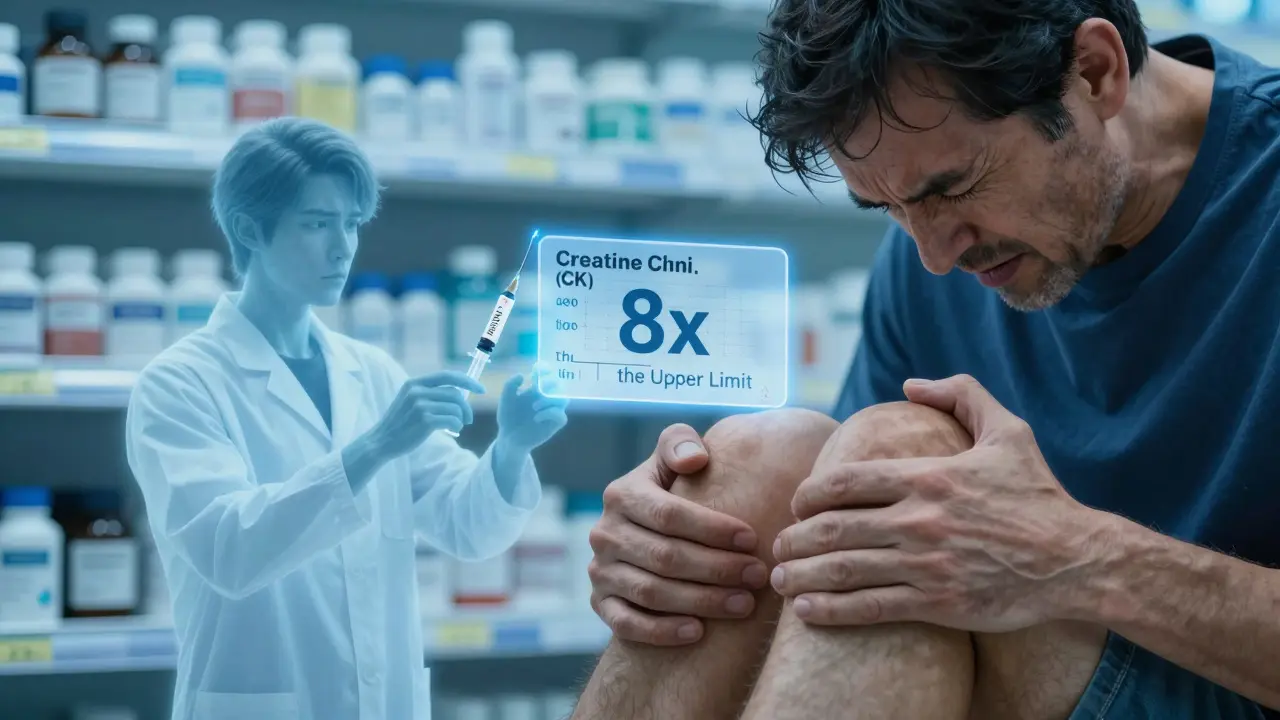
What About Muscle Pain?
Muscle aches are the most common complaint. But here’s the truth: most people who say they have statin-related muscle pain don’t actually have it. In clinical trials, placebo groups reported the same level of muscle discomfort as statin users. That’s the nocebo effect-expecting side effects makes you feel them. If you have real, persistent muscle pain, weakness, or cramps-especially if it’s in your thighs or shoulders-then check creatine kinase (CK). But don’t test right after a workout. Exercise alone can spike CK levels. Wait a few days. If CK is over 10 times the upper limit of normal, stop the statin immediately. If it’s under that? Keep going. Don’t let a single high number scare you off.What You Don’t Need to Worry About
- Monthly liver tests: Not recommended by NICE, ACC/AHA, or the FDA. Costs the U.S. healthcare system $1.2 billion a year.
- Routine HbA1c checks: Statins slightly raise blood sugar in some people, but the heart benefits far outweigh the tiny diabetes risk. Only check HbA1c if you’re prediabetic (fasting glucose 5.6-6.9 mmol/L) or obese. NICE says no routine monitoring needed.
- Cholesterol tests every 3 months: Once you’ve hit your target LDL, yearly checks are enough. More frequent testing doesn’t improve outcomes-it just adds stress and cost.
Who Needs Extra Monitoring?
Not everyone follows the same rules. Some people need more attention:- People with existing liver disease: Monitor ALT/AST every 3 months for the first year.
- Those on fibrates or other interacting drugs: These increase muscle damage risk. Watch for symptoms and consider CK testing if pain develops.
- Older adults or those with kidney problems: Higher risk for side effects. Keep an eye on creatinine and eGFR.
- People with the SLCO1B1 gene variant: This genetic quirk makes simvastatin more likely to cause muscle damage. It’s present in about 12% of Caucasians. Testing isn’t routine yet, but if you’ve had muscle issues on statins before, ask about it.

Why Do So Many Doctors Still Order Too Many Tests?
Because old habits die hard. Even though guidelines changed in 2012, many primary care doctors still order liver tests every 3 months. Why? Fear of missing something. Fear of lawsuits. Fear of patients asking, “Why didn’t you check my liver?” A 2020 survey found 78% of U.S. electronic health record systems still auto-populate quarterly liver tests as defaults. That means doctors don’t even have to think about it-they just click “order.” Patients, too, are confused. Reddit threads and patient forums are full of stories like: “My doctor stopped my statin because my ALT was 58. Normal is 40.” But normal isn’t a cliff-it’s a range. And 58 is still within the normal limits for many labs.What You Should Do
If you’re on a statin:- Ask your doctor: “What’s the plan for monitoring?”
- Request the lipid panel at 4-12 weeks and again at 12 months.
- If you feel fine, don’t push for more tests.
- If you have muscle pain, report it-but don’t assume it’s the statin.
- Keep your own record. Write down your LDL numbers and when they were taken. That way, you can spot trends.
What’s Next for Statin Monitoring?
The future is personalized. In 2023, the FDA approved new guidance for testing the SLCO1B1 gene before prescribing simvastatin. That’s a big step. Soon, we may see AI tools in electronic records flagging patients who need more monitoring based on age, weight, other meds, and past lab history. ApoB, a newer marker of cardiovascular risk, is also gaining ground. It’s more accurate than LDL for people with high triglycerides or diabetes. Some specialists are switching to it as their main tracking tool. By 2027, experts predict routine liver tests will drop by half. The message is clear: stop testing for safety when the risk is negligible. Start testing for results-because what matters isn’t your liver enzyme number. It’s whether your heart is protected.Do I need to get liver tests every 3 months on statins?
No. Current guidelines from NICE, the FDA, and the American Heart Association say liver tests are only needed before starting statins, 3 months after starting, and at 12 months. After that, only test if you have symptoms like fatigue, nausea, or yellowing skin. Routine testing doesn’t prevent liver damage and leads to unnecessary statin stops.
Can statins damage my liver?
Serious liver damage from statins is extremely rare-less than 1 case per million patient-years. Most mild elevations in liver enzymes are temporary and not caused by the drug. Isolated high ALT or AST values under 3 times the upper limit of normal don’t require stopping statins. The risk of heart attack from stopping statins is far greater than the tiny risk of liver injury.
I have muscle pain. Does that mean I can’t take statins?
Not necessarily. Most muscle pain on statins isn’t caused by the drug-it’s often the nocebo effect. If pain is mild and doesn’t interfere with daily life, keep taking it. Only check creatine kinase (CK) if pain is persistent and severe. If CK is over 10 times normal, stop the statin. If it’s lower, talk to your doctor about switching to a different statin or lowering the dose.
Should I get my HbA1c checked regularly while on statins?
Only if you’re already prediabetic or have other diabetes risk factors like obesity or high triglycerides. Statins slightly raise blood sugar, but the heart benefits outweigh this small risk. Routine HbA1c testing is not recommended by NICE or the American Heart Association for people without diabetes.
What’s the best way to know if my statin is working?
The only reliable way is a lipid panel. Check your LDL cholesterol 4 to 12 weeks after starting or changing your dose. A good response is a 30% to 50% drop. After that, yearly checks are enough if your numbers are stable. Don’t rely on how you feel-statins work silently. Your blood test is your best indicator.






14 Comments
statins dont cause liver damage lmao its always fatty liver or alcohol. why do docs still order qtr labs? lazy af.
Exactly. The guidelines changed a decade ago. If your doctor still orders monthly liver tests, ask for the evidence. Or get a second opinion.
Oh honey. I’ve seen so many patients get yanked off statins because their ALT was 58-normal range is 7–55, but let’s be real, every lab’s normal is different. Some labs say 60. Some say 70. And yet, doctors panic like it’s hepatitis C. Meanwhile, their LDL’s still at 180. The real tragedy isn’t the lab result-it’s the fear-driven medicine.
It’s not just waste. It’s dangerous. Stopping a statin for a benign enzyme spike increases your cardiac risk by 15%. That’s not a blip. That’s a death sentence disguised as caution.
I had a 72-year-old woman on rosuvastatin who got pulled off because her AST was 61. She had no symptoms. No jaundice. No fatigue. Just a number. Three months later, she had a STEMI. She was on a boat. Alone. No one saw it coming.
Doctors aren’t evil. They’re trapped. Their EHR auto-populates quarterly labs. They don’t even see the order. They just click ‘approve.’ It’s not malpractice-it’s algorithmic negligence.
And patients? They’re terrified. Reddit threads are full of ‘my doctor stopped my statin over a 59 ALT’ like it’s a crime. But the truth? The liver doesn’t care about your number. It cares about your heart. And your heart doesn’t care about your ALT. It cares about your LDL.
Stop chasing ghosts. Start chasing outcomes. If you’re not having muscle pain, don’t test CK. If you’re not jaundiced, don’t test liver enzymes. If your LDL dropped 40%, you’re winning. Period.
We’ve spent $1.2 billion a year in the US on pointless labs. That’s enough to fund 120,000 free statins for uninsured people. Instead, we’re chasing phantom risks while real people die.
It’s not about being ‘anti-test.’ It’s about being pro-heart.
Ask your doctor: ‘Is this test going to change my treatment?’ If the answer is ‘no,’ don’t do it.
And if they say ‘it’s protocol’? Tell them to read the 2012 FDA review. Or better yet-read JAMA Internal Medicine. Or better than that-read the patient who died because they were afraid of a number.
the nocebo effect is real. i had a friend who swore statins gave her muscle pain. she stopped. felt better. restarted. felt worse. turned out she was stressed about the meds. the meds weren't the issue. her brain was.
Let’s not pretend this is just about science. This is about power. Who controls the narrative? The pharmaceutical companies? The hospitals? The insurance algorithms that profit from unnecessary testing? Or the patients who are too exhausted to question their doctors? We’ve turned medicine into a ritual. Blood draws. Forms. Wait times. Results that mean nothing. And we call it ‘care.’
But the body doesn’t care about your EHR alerts. It doesn’t care if your ALT is 58 or 72. It cares if you’re alive six months from now. And if you’re still on your statin? You’re winning.
We’ve been conditioned to fear the invisible. The lab result. The number. The graph. But the only number that matters is your pulse. Your breath. Your ability to walk up the stairs without stopping. That’s the real biomarker. Not a value in a spreadsheet.
And yet-we still worship at the altar of the lab report. Like it’s scripture. Like if your AST is 60, God is angry. Like if your HbA1c is 5.8, you’re already diabetic. We’ve lost touch with the human. We’ve turned medicine into a spreadsheet.
Next time your doctor orders a test you don’t need-ask: ‘What will this change?’ If the answer is ‘nothing,’ walk out. Not because you’re rebellious. But because you’re awake.
People don’t understand that medicine is a cultural artifact. Statin monitoring protocols were built in the 1990s when labs were expensive and doctors were paranoid. Now? Labs are cheap. Algorithms are lazy. And patients are told to trust the machine. But the machine doesn’t know you. It doesn’t know your life. It doesn’t know your fear. It just spits out numbers.
And we obey. Like robots.
What’s next? Mandatory quarterly blood draws for people who eat broccoli? Because maybe it’ll raise your potassium? We’re not preventing disease. We’re manufacturing anxiety.
Stop being patients. Start being people.
Biggest myth: statins cause diabetes. They slightly raise blood sugar. But for every 255 people on statins, one extra case of diabetes occurs over 4 years. Meanwhile, they prevent 5 heart attacks. That’s not a trade-off. That’s a win. The math is clear. Don’t let fear rewrite the numbers.
you think this is about science? nah. it’s about control. the pharmaceutical industry pushed these guidelines because they knew people would panic over liver tests and stop taking statins. but they don’t want you to stop. they want you to keep paying. every lab test? billed. every follow-up? billed. every unnecessary refill? billed. they profit from your fear. and your doctor? they’re just following the script. the script written by the same people who told you smoking was safe.
they told you statins were miracle drugs. then they told you to get tested every 3 months. why? because if you stop, they lose money. if you keep testing, they make money. it’s not about your health. it’s about their bottom line.
i had a friend get dropped from her statin because her ALT was 57. she cried for weeks. she thought she was dying. but she was fine. her liver was fine. her heart? still at risk. and now she’s off the drug. because the system scared her into it.
they don’t care if you live. they care if you pay.
next time your doctor orders a test, ask: ‘who profits from this?’ if they hesitate? run.
India sees this too. Doctors here still order monthly liver tests. Patients panic. Stop statins. Heart attacks follow. The science is global. But fear? Fear is local. We need to teach people: your number is not your fate. Your heart is.
While the evidence supports reduced monitoring, implementation remains inconsistent. Many primary care physicians lack time or training to update protocols. Systemic change requires not just guidelines, but education, EHR redesign, and patient advocacy. Until then, patients must be their own best advocates.
Interesting how the SLCO1B1 gene testing isn’t routine yet. We’ve had pharmacogenomics for over a decade. Why isn’t it standard? Cost? Lack of awareness? Or is it because we still treat medicine like trial-and-error instead of precision science?
Imagine if we tested for warfarin sensitivity before prescribing it. We do. Why not statins? The tech exists. The data exists. The only thing missing is the will.
It’s not just about outdated guidelines. It’s about the medical-industrial complex weaponizing uncertainty. If you don’t test, you’re negligent. If you do test, you’re overtreating. Either way, the doctor gets covered. The patient? They’re the one left holding the bag of unnecessary anxiety, cost, and potential harm.
And let’s be honest-how many doctors have ever lost a lawsuit because they didn’t order a liver test? Zero. But how many have lost patients to heart attacks because they stopped a statin over a 58 ALT? Countless.
This isn’t medicine. It’s liability management dressed in white coats.
Apob is the future. LDL is outdated for people with metabolic syndrome. Triglycerides high? HDL low? ApoB tells you the real particle count. No more guessing. Just direct measurement. Why aren’t we using it everywhere yet? Because labs still bill by LDL. And change is slow.
My doctor still auto-orders liver tests every 3 months. I had to print out the 2012 FDA guidelines and hand them to her. She said, ‘I didn’t know they changed.’ That’s the problem. Not patients. Not statins. The system.