
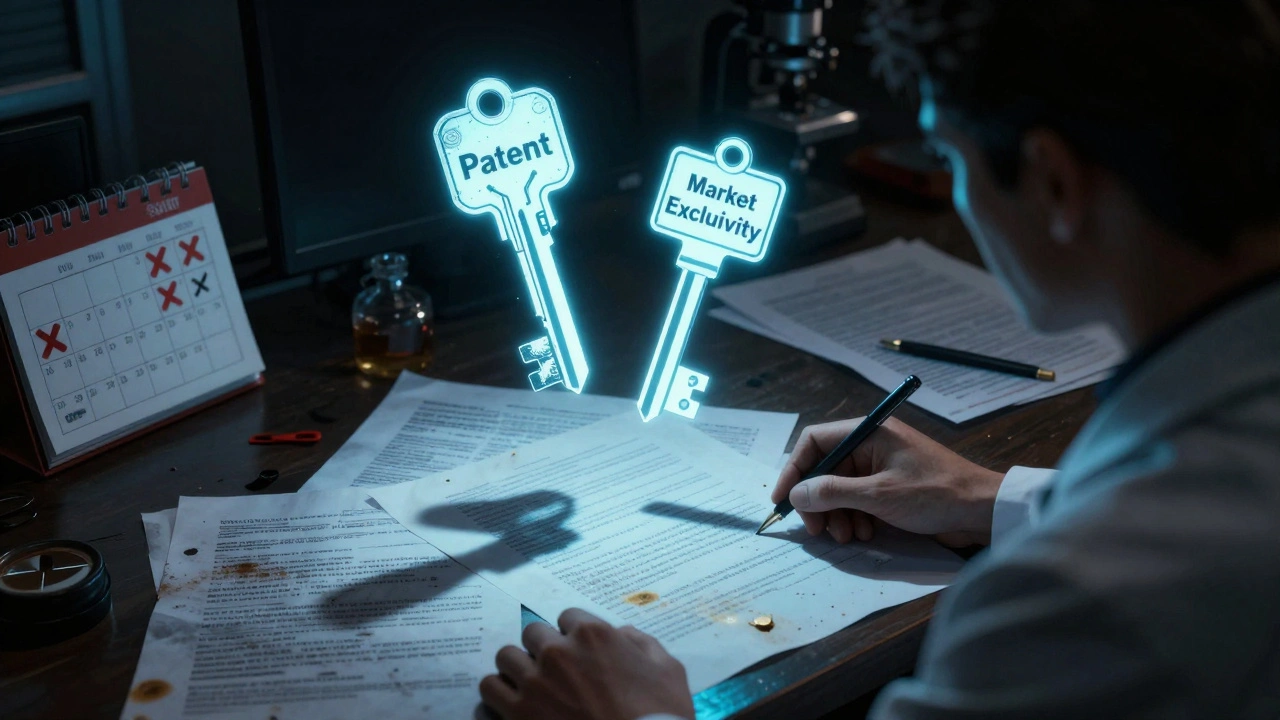
When a new drug hits the market, it doesn’t just come with a price tag-it comes with a legal shield. Two kinds of shields exist: patent exclusivity and market exclusivity. They sound similar, but they’re not the same. And confusing them can cost companies millions-or keep life-saving drugs unaffordable for years.
Patent Exclusivity: The Legal Right to Block Copies
Patent exclusivity comes from the U.S. Patent and Trademark Office (USPTO). It’s a 20-year clock that starts ticking the day a drug’s inventor files for a patent-not when the drug gets approved. That’s critical. Most drugs take 10 to 15 years just to get through clinical trials and FDA review. So by the time a drug hits shelves, it might only have 5 to 8 years of actual patent life left.
Patents protect specific inventions: the chemical structure, how it’s made, how it’s used, or even the pill’s coating. The strongest patent is the composition of matter-it covers the actual molecule itself. But many companies file secondary patents later: for new dosages, new delivery methods, or new uses. These can extend protection without inventing anything new.
Here’s the catch: patents don’t automatically stop generics. The patent holder has to sue anyone who copies the drug. That’s expensive, slow, and uncertain. Many generic makers challenge patents in court. In fact, over 68% of patents listed in the FDA’s Orange Book are secondary patents, not the original composition patents. That means a lot of the protection is shaky.
Market Exclusivity: The FDA’s Automatic Lock
Market exclusivity is different. It’s not about invention. It’s about data. The FDA grants this automatically when a drug is approved-if the company met certain conditions. No lawsuits needed. No court battles. The FDA just won’t approve a generic version until the clock runs out.
There are several types:
- New Chemical Entity (NCE) exclusivity: 5 years. During this time, the FDA can’t even accept an application for a generic version. Even if the patent expired, the generic can’t get in.
- Orphan drug exclusivity: 7 years for drugs treating rare diseases (under 200,000 patients in the U.S.). This applies even if the drug isn’t patented.
- Pediatric exclusivity: 6 extra months added to any existing patent or exclusivity period if the company does extra studies on kids.
- Biologics exclusivity: 12 years for complex protein-based drugs like Humira or Enbrel. This was created in 2009 and is one of the biggest barriers to biosimilar competition.
- 180-day exclusivity: The first generic company to challenge a patent and win gets a 6-month head start on other generics. This is worth hundreds of millions in revenue.
Here’s the wild part: a drug can have market exclusivity even if it’s not patented at all. In 2010, Mutual Pharmaceutical got 10 years of exclusivity for colchicine-a drug used since ancient Egypt. It had no patent. But because they submitted new clinical data to prove its safety for a new use, the FDA gave them exclusivity. The price jumped from 10 cents per pill to nearly $5. That’s market exclusivity in action.
Why Both Exist: A Deliberate Balance
The system wasn’t designed to trap patients. It was built in 1984 by the Hatch-Waxman Act to strike a balance. On one side, you need to reward innovation-drug development costs an average of $2.3 billion and takes over a decade. On the other, you need generics to bring prices down after the investment is paid back.
Patents reward invention. Market exclusivity rewards the effort of proving a drug is safe and effective. You can have one without the other. In fact, FDA data from 2021 shows:
- 38.4% of branded drugs have patents but no exclusivity
- 5.2% have exclusivity but no patent
- 27.8% have both
- 28.6% have neither
That last group? Those are older drugs, often off-patent and never protected by exclusivity. They’re the ones generics can copy right away.
Real-World Confusion and Costly Mistakes
Companies get this wrong all the time. A 2022 survey by the Biotechnology Innovation Organization found that 43% of small biotech firms thought having a patent meant they automatically had market exclusivity. They didn’t file for FDA exclusivity-and lost out on years of protection. One company missed out on $1.7 million in potential revenue because of a paperwork error.
Even big players stumble. Teva Pharmaceuticals spent years waiting to launch a generic version of Trintellix, an antidepressant. The patent expired in 2021-but the FDA still blocked them because of 3 years of market exclusivity. Teva didn’t get to sell until 2024. That delay cost them an estimated $320 million.
On the flip side, innovator companies often fail to claim all the exclusivity they’re entitled to. Scendea Consulting found that between 2018 and 2022, 22% of drug applicants didn’t submit proper paperwork for exclusivity. That left an average of 1.3 years of protection on the table per drug. That’s free money left behind.
What’s Changing Now?
The rules are shifting. In 2023, the FDA launched its Exclusivity Dashboard, a public tool that shows exactly when each drug’s exclusivity ends. Generic makers are using it to plan their entries months in advance. Transparency is good-but it’s also making the race tighter.
Legislation is also on the table. The PREVAIL Act of 2023 proposes cutting biologics exclusivity from 12 years to 10. That could open the door to cheaper biosimilars sooner. Meanwhile, global pressure is growing. The WTO’s temporary waiver for COVID-19 vaccines has sparked debate: should exclusivity be relaxed for other critical drugs?
Analysts at McKinsey predict that by 2027, regulatory exclusivity will account for over half of all drug market protection time-more than patents. Why? Because patents are getting weaker. Courts are striking down secondary patents more often. Companies are shifting their focus from patent thickets to exclusivity claims.
Who Wins? Who Loses?
For patients, the system is a mixed bag. Exclusivity keeps prices high for years after a drug is approved. But it’s also what makes drug development possible. Without the promise of 10+ years of protection, companies wouldn’t risk billions on drugs for rare diseases or complex conditions.
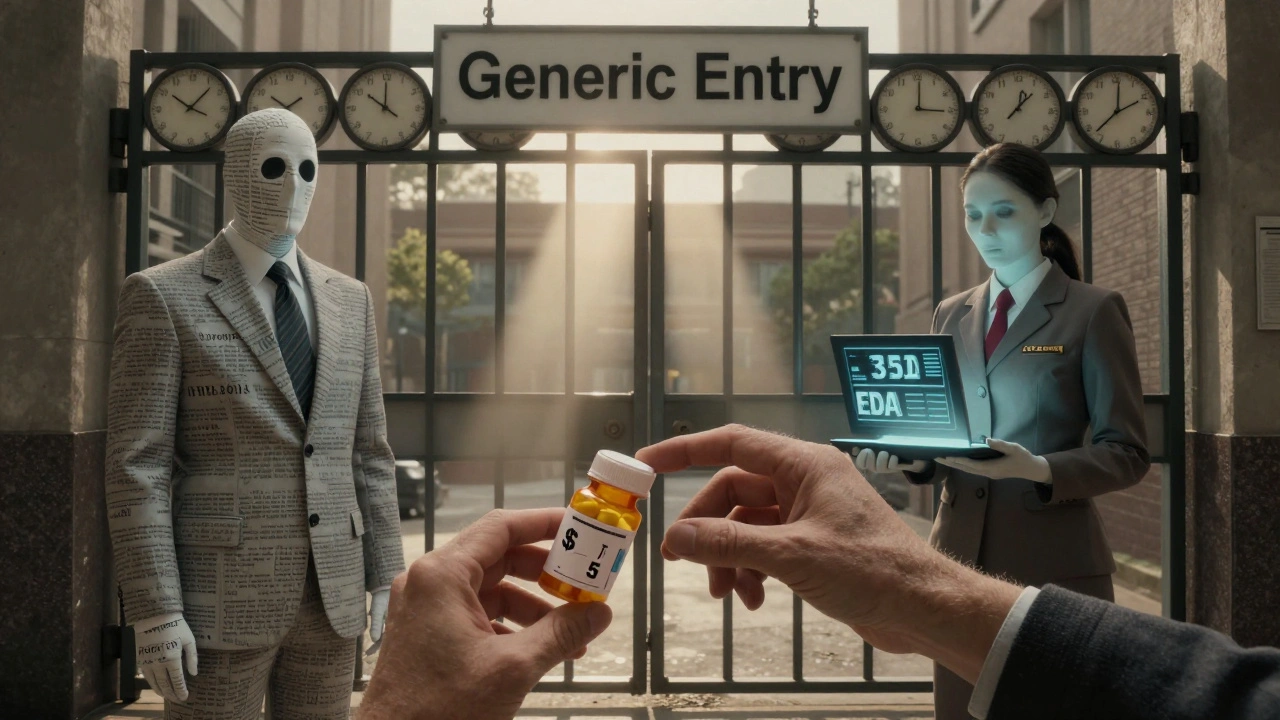
For generics, exclusivity is the biggest barrier. Even if they can copy the drug chemically, they can’t get approval until the clock runs out. That’s why the 180-day exclusivity for the first generic challenger is so valuable-it’s their only shot at dominating the market before others join.
For the FDA, it’s about enforcement. They don’t decide if a drug is innovative. They just check if the paperwork is right. That’s why so many exclusivity claims get denied-not because the drug doesn’t qualify, but because the submission was incomplete. The FDA takes an average of 45 days to review each claim, and 12% of them need corrections.
And for investors? The numbers speak for themselves. The average branded drug earns 65% of its total lifetime revenue in the first year after approval-when both patent and exclusivity protections are still active. That’s why companies fight so hard to extend them.
Bottom Line: Two Keys, One Lock
Think of patent exclusivity and market exclusivity like two different keys to the same lock. One key (patent) is held by the inventor. The other (market exclusivity) is held by the FDA. You need both to keep generics out. Lose one key, and the lock opens-even if the other key still works.
For patients, this means drug prices stay high longer than you might expect. For companies, it means legal teams and regulatory specialists are just as important as scientists. For the system to work, everyone needs to understand: patents protect invention. Market exclusivity protects approval.
And if you’re wondering why your prescription costs so much? Look beyond the patent. Check the exclusivity clock. It might be the real reason you’re still paying brand prices.
Can a drug have market exclusivity without a patent?
Yes. Market exclusivity is granted by the FDA based on the data submitted for approval, not on whether the drug is patented. For example, colchicine had no patent but received 10 years of exclusivity because the company submitted new clinical data for a new use. Orphan drugs also get 7 years of exclusivity regardless of patent status.
How long does FDA market exclusivity last?
It varies: 5 years for a new chemical entity, 7 years for orphan drugs, 12 years for biologics, and 6 months added to existing protections if pediatric studies are done. First generic applicants who challenge a patent get 180 days of exclusivity.
Does patent extension count toward market exclusivity?
No. Patent Term Extension (PTE) extends the patent life-up to 5 years beyond the original 20-year term-but only if the delay was caused by FDA review. This extension runs alongside exclusivity but doesn’t change the exclusivity period. The FDA doesn’t adjust exclusivity based on patent changes.
Why do some drugs cost more even after the patent expires?
Because market exclusivity may still be in effect. Even if a patent expires, the FDA can block generic versions until the exclusivity period ends. For example, a drug with 5-year NCE exclusivity stays protected for 5 years after approval-even if the patent expired 2 years earlier.
Can a generic drug enter the market before exclusivity ends?
Only if it challenges the patent and wins. The first generic company to file a Paragraph IV certification (challenging a listed patent) can get 180 days of exclusivity. But if the drug has market exclusivity, even a successful patent challenge won’t allow entry until the exclusivity period ends.
What’s the difference between data exclusivity and market exclusivity?
Data exclusivity means the FDA can’t use the innovator’s clinical trial data to approve a generic. Market exclusivity means the FDA can’t approve the generic at all. In the U.S., these are often bundled: 5-year NCE exclusivity includes both. In the EU, they’re separate: 8 years data exclusivity, then 2 years market exclusivity.
How do I check when a drug’s exclusivity ends?
The FDA’s Exclusivity Dashboard, launched in September 2023, lists all active exclusivity periods for approved drugs. You can search by brand name or active ingredient to see when generic entry is legally allowed.

14 Comments
So let me get this straight - we’re letting pharma giants stretch monopolies by filing patents for pill coatings? 🤦♀️ And the FDA just rolls over? This isn’t innovation - it’s legalized extortion. I pay $800 for a pill that costs 7 cents to make, and you tell me this system is ‘balanced’? Nah. It’s broken. And it’s killing people.
Ugh. Another one of these ‘let’s pretend big pharma is just trying to help’ essays. Newsflash: they don’t care about patients. They care about quarterly earnings. If you think the 12-year biologics exclusivity is about science, you’re not paying attention.
Great breakdown - seriously, this is one of the clearest explanations I’ve seen. A lot of people think patents = monopoly, but market exclusivity is the real silent killer. That colchicine example? Perfect. It’s not about invention, it’s about paperwork. And companies are *so* bad at filing it right. I’ve seen startups lose millions because their legal team thought ‘patent = automatic protection.’ Nope. FDA doesn’t care about your patent if you didn’t submit the right form. It’s like winning the lottery but forgetting to claim it.
It’s fascinating how we’ve turned medicine into a legal chess game. Patents are about invention, exclusivity is about proof - and yet, we treat them as interchangeable. But maybe the deeper question is: why do we let corporations hold life-saving tools hostage for decades? Is it really about ‘rewarding innovation,’ or is it about letting profit dictate access? I wonder if we’d be better off with a public prize system - reward the science, but make the results public immediately. No patents. No exclusivity. Just medicine, as a human right.
Love this breakdown! I work in regulatory affairs and this is exactly what we train new hires on - patents vs. exclusivity. So many people don’t realize that even if a patent dies, the FDA can still block generics for years. That Teva example? Classic. Also, the 180-day exclusivity for first filers? That’s the wild west of generics - some companies will literally sue their own investors to lock in that window. It’s nuts, but it works.
EVERYTHING here is a lie. The FDA doesn’t ‘grant’ exclusivity - they’re forced into it by Big Pharma lobbyists. The whole system is a front. They’re not protecting innovation - they’re protecting stock prices. And the ‘Exclusivity Dashboard’? That’s not transparency - it’s a kill switch. They’re telling generic companies: ‘Here’s when to strike. We’ve already planned the price hikes.’ This isn’t regulation. It’s a cartel. 🕵️♀️💸
While I appreciate the thoroughness of this exposition, I must emphasize, with the utmost gravity, that the conflation of patent term extension with market exclusivity represents a fundamental misinterpretation of U.S. regulatory architecture. The FDA, in its administrative capacity, does not possess the authority to modify exclusivity periods based upon patent adjustments - a point which, regrettably, is frequently misunderstood by even seasoned industry professionals. One must consult 21 C.F.R. § 314.108 with diligence. 📑⚖️
Oh wow. Another whitepaper dressed up as a Reddit post. You really think this is ‘balanced’? You’re one of those people who say ‘they need to make money’ while your neighbor can’t afford insulin. Congrats. You’re not a thinker. You’re a shill. 💸
It’s wild how we’ve turned medicine into a game of monopoly where the rules are written by lawyers and the board is made of stock tickers. I mean - colchicine? Ancient Egyptian medicine. A drug older than democracy gets a 10-year monopoly because someone filed a form? That’s not capitalism. That’s feudalism with a corporate logo. And the 180-day window for first generics? That’s not competition - that’s a lottery ticket for billionaires. Who even gets to play? Only the ones with legal teams bigger than some small countries.
Man, I didn’t even realize market exclusivity was a thing until I read this. I thought if the patent expired, generics could just jump in. Nope. The FDA’s got its own clock. That’s wild. I’m gonna start checking the Exclusivity Dashboard before I fill prescriptions. Might save me a few bucks. Thanks for the clarity - this stuff should be on every pharmacy’s website.
There’s something deeply human here - we want to reward effort, but we’ve built a system that rewards paperwork more than patients. The fact that a drug can sit on shelves for 10 years at $1000 a pill because someone forgot to check a box? That’s not failure of innovation. That’s failure of empathy. Maybe we need a system where the goal isn’t ‘how long can we keep prices high’ - but ‘how fast can we get this to the people who need it?’
Bro. The FDA is literally the gatekeeper. 🚪💊 Patents? Meh. Exclusivity? That’s the real lock. And the 180-day thing? That’s the golden ticket. 🎫💸 I just got my insulin bill. $800. And I know why. Not because of patents. Because of exclusivity. And nobody’s talking about it. #PharmaScam