
19 Jan |
12:07 PM
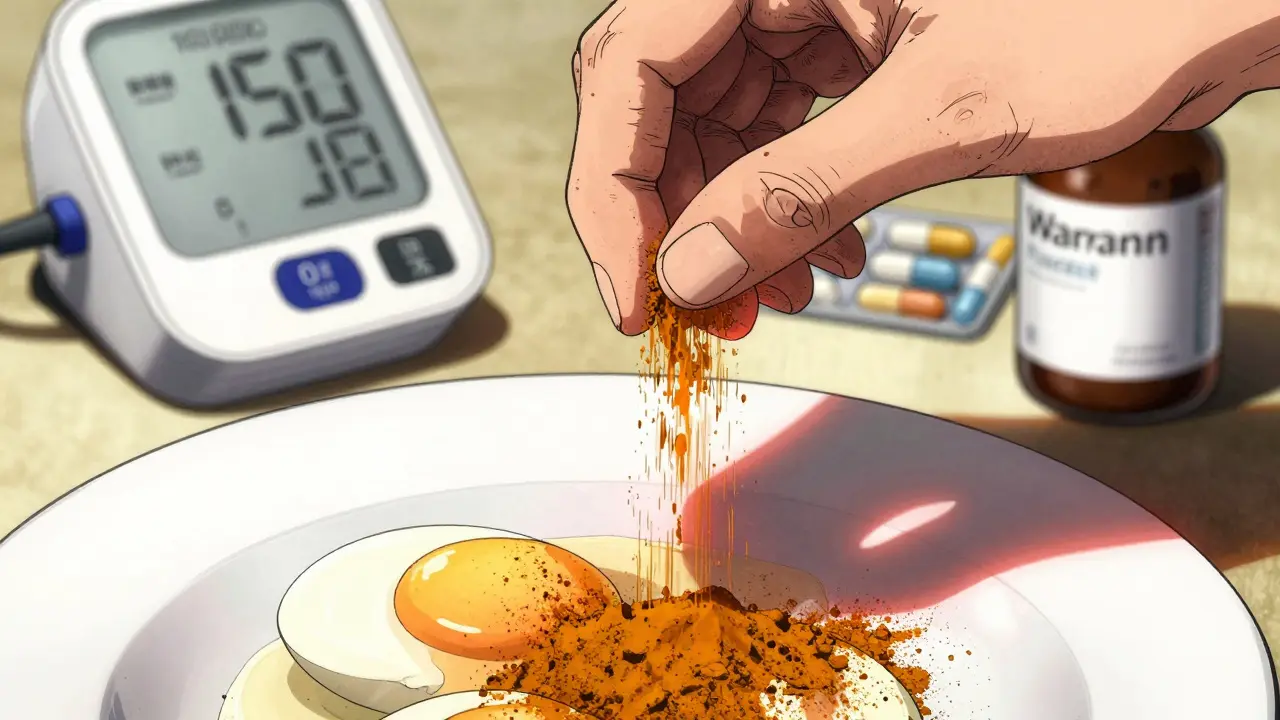
Every morning, millions of people sprinkle turmeric on their eggs, stir it into golden milk, or swallow capsules labeled "1000mg curcumin"-thinking they’re doing something healthy. But if you’re on a blood thinner, that spice could be quietly putting you at risk for serious, even life-threatening bleeding.
Why Turmeric Isn’t Just a Spice Anymore
Turmeric comes from the root of Curcuma longa, a plant used for thousands of years in Ayurvedic medicine and South Asian cooking. Its bright yellow color? That’s curcumin-the compound behind most of its health claims. But here’s the catch: curcumin doesn’t just fight inflammation or boost antioxidants. It also interferes with how your blood clots. In lab studies, curcumin slows down clotting by directly inhibiting key proteins like thrombin and Factor Xa. These are the same targets of powerful prescription blood thinners like warfarin and rivaroxaban. Unlike those drugs, though, curcumin doesn’t have a clear, consistent dose. A teaspoon of ground turmeric might contain 20-40mg of curcumin. A supplement? That could be 500mg or more. And concentrated extracts? Some pack up to 95% curcumin. That’s not a spice anymore-it’s a pharmacologically active substance.The Real Danger: When Natural Meets Prescription
You might think, "It’s natural, so it’s safe." But nature doesn’t care about your INR numbers. In April 2018, New Zealand’s Medsafe issued a formal warning after a patient on stable warfarin therapy saw their INR skyrocket to over 10-more than triple the upper safe limit. The only new variable? They started taking a turmeric supplement. INR measures how long it takes your blood to clot. Normal range for someone on warfarin is 2-3.5. Above 4? Risk of bleeding rises. Above 10? You’re in emergency territory. That patient didn’t have a stroke or fall. They just added turmeric to their routine. And within weeks, their blood lost the ability to clot properly. The Welsh Medicines Information Centre (WMIC) confirmed this isn’t an isolated case. In another report, a transplant patient took 15 or more spoonfuls of turmeric powder daily for ten days. Result? Kidney damage and toxic levels of tacrolimus-a drug that must be tightly controlled. Turmeric wasn’t just thinning blood. It was interfering with how the liver processed other medications.Which Blood Thinners Are at Risk?
This isn’t just about warfarin. Turmeric interacts with nearly every type of blood thinner:- Warfarin (Coumadin): Curcumin slows its breakdown in the liver, causing levels to build up dangerously.
- DOACs (rivaroxaban, apixaban, dabigatran): Curcumin inhibits Factor Xa-the same target these drugs hit-adding up to a double hit on clotting.
- Aspirin, clopidogrel (Plavix): Turmeric reduces platelet aggregation, making these antiplatelet drugs even stronger.
- Heparin, enoxaparin (Lovenox), dalteparin (Fragmin): Combined with turmeric’s anticoagulant effects, these can lead to uncontrolled bleeding.
- NSAIDs like ibuprofen or naproxen: Turmeric adds to their blood-thinning effect, raising the risk of stomach bleeds or bruising.

Why Supplements Are Riskier Than Spices
Eating turmeric in curry? Probably fine. A pinch here and there won’t push your INR out of range. But supplements? That’s a different story. Think of it this way: if you eat curry with turmeric, you’re getting maybe 50mg of curcumin per meal. A single capsule of a "high-potency" supplement can deliver 500mg. That’s ten times more. And because supplements aren’t regulated like drugs, you don’t know what you’re actually getting. One brand might have 8% curcumin. Another might have 95%. No label tells you how much is really inside. Plus, turmeric doesn’t just affect clotting. It also blocks the CYP3A4 enzyme in your liver-the same enzyme that breaks down dozens of other medications. That means if you’re taking statins, antidepressants, immunosuppressants, or even some antibiotics, turmeric can cause those drugs to build up to toxic levels. One study showed sulfasalazine levels jumped 3.2 times higher when taken with 2g of curcumin daily. That’s not a minor interaction. That’s a drug overdose waiting to happen.What Doctors Are Saying Now
The medical community isn’t guessing anymore. The evidence is clear. - Medsafe (New Zealand) says: "Concurrent use of turmeric/curcumin with blood thinners should be avoided." - WMIC (UK, 2024 update): "Raised INR to dangerous levels has been reported. Monitor closely if used together-but avoidance is safest." - Mayo Clinic: "Turmeric in large doses can act like a blood thinner, causing bleeding or dangerously enhancing the effects of blood-thinning medications." - Healthline: "If you’re on anticoagulants, don’t take turmeric supplements without talking to your doctor." Dr. Oracle, a clinical pharmacologist, put it bluntly: "The risk is particularly significant with warfarin because of its narrow therapeutic index. There’s a tiny window between effective and toxic. Turmeric can push you right over the edge."
What You Should Do
If you’re on a blood thinner:- Don’t start turmeric supplements. Not even "just a little."
- If you’re already taking them, stop. Tell your doctor. Don’t wait for symptoms.
- Get your INR checked. If you’ve taken turmeric recently, your doctor may need to test your clotting time immediately.
- Stop turmeric supplements at least two weeks before any surgery or dental work. Even minor procedures can turn dangerous.
- Don’t assume "natural" means safe. Herbs can be just as powerful-and dangerous-as pills.



14 Comments
Just had my INR checked last week-was hovering at 3.1. Started cutting out turmeric supplements two weeks ago after reading this. My doc was shocked I didn’t know the risk. Seriously, people think ‘natural’ means ‘safe’-nope. It’s biology, not a yoga retreat. 🙏
This is why I stopped taking that ‘miracle spice’ crap after my uncle bled out from a nosebleed that wouldn’t stop-he was on warfarin and thought turmeric was ‘just for inflammation.’ He didn’t make it to the hospital. No more ‘natural’ lies.
Man, I used to mix turmeric into my morning smoothie like it was oatmeal. Thought I was being healthy. Then my cousin-she’s a nurse-sat me down and said, ‘You’re not a lab rat, Steve.’ She showed me the studies. I stopped cold. No regrets. Your body doesn’t care if it’s organic or not-it just reacts. And sometimes, it reacts hard.
My knees still ache, sure. But I’d rather ache than end up in the ER with a brain bleed because I trusted an Instagram influencer over my pharmacist. We gotta stop romanticizing herbs like they’re fairy dust. They’re potent. They’re powerful. And they don’t come with a warning label.
I told my whole family. My mom’s on blood pressure meds now. She’s not taking turmeric either. My sister’s in her 50s, on aspirin-she’s switching to ginger tea. Smells better anyway.
It’s not about fear. It’s about awareness. You don’t need a supplement to be healthy. You need knowledge. And maybe a good doctor who doesn’t roll their eyes when you ask about ‘natural remedies.’
Stop glorifying the ‘ancient wisdom’ when it’s literally risking your life. That’s not tradition-that’s negligence. And I’m tired of seeing people get hurt because they thought ‘it’s just a spice.’
My grandma used turmeric in curries. Once a week. Not three capsules a day. There’s a difference between culinary use and pharmacological assault.
Don’t be the person who says ‘I didn’t know.’ You know now. Act on it.
Curcumin’s inhibition of CYP3A4 and Factor Xa is well-documented in pharmacokinetic literature. The interaction with DOACs is particularly concerning due to synergistic anticoagulant effects. The lack of standardization in supplement formulations renders dosing unpredictable, which fundamentally undermines safe use. Regulatory gaps in the dietary supplement industry are not merely inconvenient-they are lethal in this context.
Let’s be real-this isn’t about turmeric. It’s about the entire wellness industry’s obsession with turning plants into pharmaceuticals without the oversight. People swallow capsules labeled ‘1000mg curcumin’ like they’re vitamins, but they’re essentially self-prescribing a drug with no pharmacokinetic data, no FDA approval, and zero quality control. And then they wonder why they’re bleeding internally. It’s not ‘natural’-it’s reckless. The fact that this is even a debate is terrifying.
As an American citizen, I find it deeply offensive that our healthcare system allows unregulated, foreign-derived supplements to be marketed as health products while prescription medications face hundreds of millions in testing. This isn’t ‘natural healing’-it’s a regulatory failure. Why are we letting Indian spice traders dictate the safety of our citizens’ anticoagulant therapy? This needs congressional hearings.
Just wanted to add-my dad took turmeric supplements for arthritis for 3 years. He didn’t tell his cardiologist. One day, he woke up with a massive bruise across his chest-no fall, no trauma. INR was 8.7. ICU for 5 days. They reversed it with vitamin K and plasma. He’s fine now. But he’ll never take another supplement without a doctor’s okay. Seriously, folks-don’t be like my dad. Talk to your provider. Even if you think it’s ‘harmless.’ It’s not.
Oh my GOD. I’ve been taking turmeric for 5 years. I’m a yoga teacher. I’ve posted 200 Instagram stories about it. I’m crying right now. My mom had a stroke last year-could this have been why? I’m deleting every supplement I own. I’m so ashamed. I thought I was helping myself. I was poisoning myself.
Been on Xarelto for AFib. Took turmeric for a month because my buddy said it ‘reduces inflammation.’ Didn’t think much of it. Then I started bruising like a toddler who fell off a bike. Went to the doc-INR equivalent was through the roof. Stopped it. Bruises faded in 10 days. Don’t be dumb. Your body isn’t a chemistry set. 🙏
My grandma always put turmeric in her rice. Never had a problem. But she never took pills. Maybe the problem isn’t the spice-it’s the greed behind the supplement industry. Just saying.
This is fake news. Turmeric is from India. We use it for thousands of years. You Americans are weak. You take pills for everything. My uncle, he had diabetes, he took turmeric, he live to 95. You don’t know what you talking about.
As someone raised in a household where turmeric was medicine and food, I get the cultural weight here. But modern science isn’t rejecting tradition-it’s refining it. My grandmother used a pinch in curry. We now have pills with 500mg of extracted curcumin. That’s not tradition-it’s pharmacology. Respect the roots, but don’t confuse a spice rack with a pharmacy.
And hey-if you’re from India or Nigeria or anywhere else where turmeric is part of daily life, you’re probably not taking 10 capsules a day. So this post isn’t about your culture. It’s about capitalism selling your heritage as a drug.
It is not merely irresponsible-it is a moral failure to promote unregulated botanicals as therapeutic agents without peer-reviewed, double-blind, placebo-controlled trials. The FDA’s inability to regulate dietary supplements under DSHEA is a scandal of epic proportions. The public is being deliberately misled by marketing departments masquerading as health educators. Turmeric, in concentrated form, is a drug-by definition, by mechanism, by outcome. And yet, we allow it to be sold on Amazon like a novelty item. This is not a public health issue-it is a public betrayal.
They’re lying. This is all a Big Pharma plot to sell more warfarin. Turmeric is natural. They want you scared so you keep buying their pills. My cousin’s friend’s neighbor took turmeric and got better. They just don’t want you to know.