
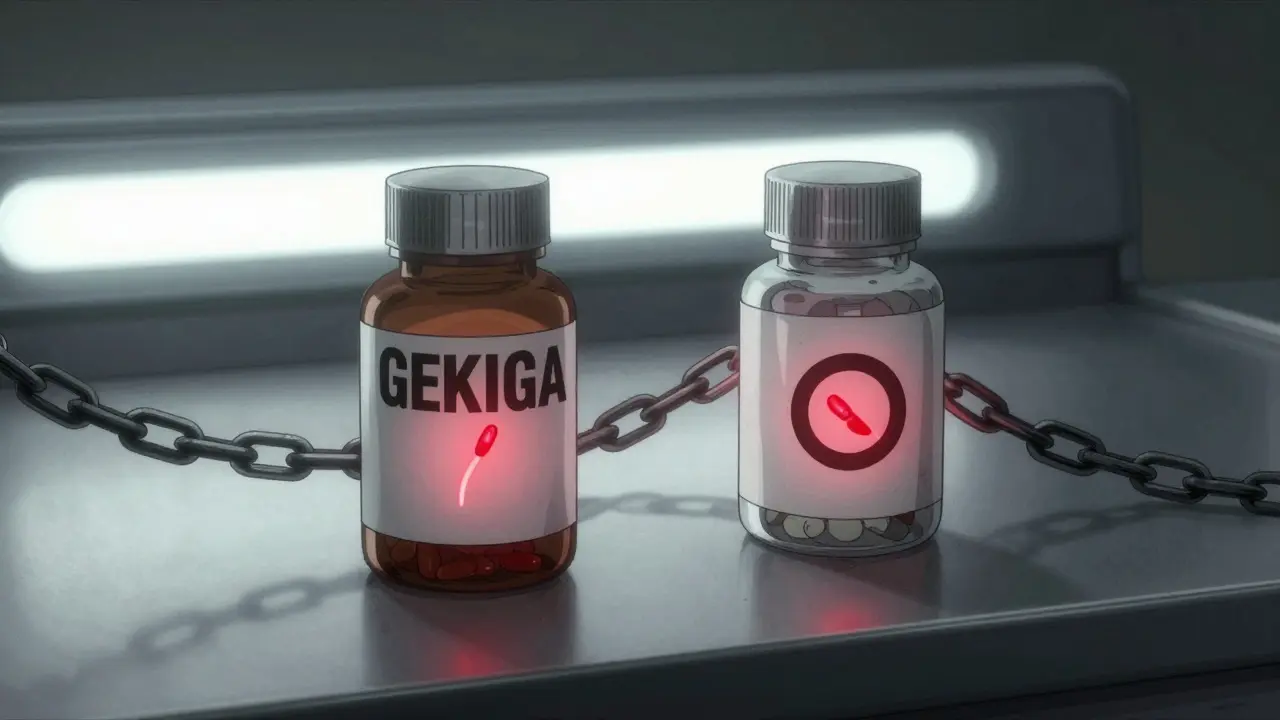
Drug interactions don’t care if your pill is generic or brand-name
If you’ve ever switched from a brand-name medication to a generic version, you’ve probably wondered: does this change how my drugs interact? Maybe you heard a story about someone who felt different after the switch. Or maybe your pharmacist mentioned it’s the same thing, but you’re still unsure. The truth is simpler than the rumors: drug interactions depend almost entirely on the active ingredient - not whether the pill was made by Pfizer or a generic manufacturer.
The U.S. Food and Drug Administration (FDA) requires generic drugs to contain the exact same active ingredient, in the same strength, and delivered the same way as the brand-name version. That means if you’re taking a generic version of lisinopril, it’s still lisinopril - same molecule, same effect on your blood pressure. The same goes for sertraline, metformin, or atorvastatin. If two drugs interact with each other because of their chemical structure, it doesn’t matter if one is branded or generic. The interaction happens because of the active ingredient.
How the FDA ensures generics work the same
Before a generic drug hits the shelf, it must pass a strict test called bioequivalence. This isn’t just a paperwork check. It’s a real-world test done with healthy volunteers. Researchers measure how quickly and how much of the drug enters the bloodstream - looking at two key numbers: Cmax (peak concentration) and AUC (total exposure over time). The generic must deliver the drug within 80% to 125% of the brand-name drug’s levels. That’s a 45% range, which sounds wide, but in practice, most generics fall within 5% of the original.
For most drugs, this margin is more than enough. But for drugs with a narrow therapeutic index - like warfarin, lithium, or levothyroxine - the rules tighten. The FDA requires a tighter range of 90% to 111% for these. Why? Because tiny changes in blood levels can cause big problems. Even then, the risk of interaction doesn’t come from the generic label. It comes from the active ingredient itself.
The FDA’s Orange Book lists over 12,000 approved generic drugs, and each one is tied to its brand-name counterpart. Pharmacists and doctors can look up these matches to confirm equivalence. The system works. A 2020 study in Scientific Reports tracked over 17,000 patients on generic versus brand-name cardiovascular drugs. The results? Patients on generics had fewer heart attacks, strokes, and deaths. Not because generics are safer, but because more people could afford to take them regularly.
What’s actually different in generic drugs
Here’s where confusion creeps in: generics can have different fillers, dyes, and binders. These are called excipients. They don’t treat your condition. They just help the pill hold together, dissolve properly, or look a certain way. But they can matter - just not in the way most people think.
For example, if you’re lactose intolerant, a generic version of a drug might use lactose as a filler, while the brand version uses cornstarch. That won’t cause a drug interaction with your other meds - but it could give you bloating or diarrhea. That’s not an interaction. That’s a food sensitivity.
Same with allergies. If you’re allergic to a dye like FD&C Red No. 40, and the generic version uses that dye while the brand doesn’t, you might get a rash. Again - not a drug interaction. Just an ingredient mismatch. The active ingredient is still doing the same job. The problem is the packaging, not the medicine.
That’s why pharmacists at major hospitals now check excipients when patients report new side effects after switching. They don’t assume the drug isn’t working. They look at the pill’s ingredients list - which the FDA now requires to be publicly available in the Orange Book.

Are generic drugs more likely to cause interactions?
Let’s look at the data. From 2015 to 2020, the FDA’s adverse event database recorded 0.78% of brand-name drug cases linked to interactions. For generics, it was 0.82%. That difference? Statistically meaningless. No real signal. No trend.
Some people swear they felt different after switching. A Reddit thread from late 2023 had over 140 comments. Most users said they noticed no change. But 22% reported something - increased drowsiness, nausea, or anxiety. When you dig into those stories, many involve drugs like zolpidem (Ambien) or levothyroxine. These are often the same drugs where people report feeling “not right” after switching - even when blood tests show identical levels.
This isn’t magic. It’s psychology. Studies show that when patients believe a generic is “inferior,” they’re more likely to notice and report side effects. That’s called the nocebo effect - the opposite of placebo. One 2022 Consumer Reports survey found that 18% of people thought generics had higher interaction risks. But only 4% had actually experienced a difference. The gap between belief and reality is wide.
When you should be cautious
There are a few situations where switching between generics - or between generic and brand - needs extra care.
- Narrow therapeutic index drugs: Warfarin, digoxin, phenytoin, cyclosporine. Small changes in blood levels matter. If you’re stable on one version, don’t switch unless your doctor approves.
- Multiple generic manufacturers: If your pharmacy switches from one generic to another (say, from Teva to Mylan), and you notice new symptoms, it could be the excipients - not the active drug.
- Older adults on multiple meds: The more drugs you take, the higher the chance of interaction. Stick with one version if it’s working. Don’t chase savings if it causes confusion.
For most people, though, switching is safe. In fact, it’s better. Generic drugs save the U.S. healthcare system over $1.6 trillion a decade. That means more people can afford their meds. And taking your meds as prescribed is the #1 way to avoid dangerous interactions.

What doctors and pharmacists really think
Dr. Aaron Kesselheim, a professor at Harvard Medical School, put it plainly: “The vast majority of evidence suggests that generic drugs are therapeutically equivalent to their brand-name counterparts, including regarding drug interaction profiles.”
The American College of Clinical Pharmacology agrees. Their 2020 statement says bioequivalent products should be expected to have equivalent interaction potential. The FDA’s own position is clear: differences in inactive ingredients don’t change how the drug works or how it interacts with other medicines.
But here’s the nuance: if you’re on a complex regimen - say, taking six drugs for heart disease, diabetes, and depression - your pharmacist might recommend staying on the same generic version. Not because one is better. But because consistency reduces confusion. If you’re on a brand-name drug and it works, there’s no reason to switch. If you’re on a generic and it works, don’t switch to brand unless cost is a barrier.
What you can do to stay safe
Here’s a simple checklist to follow:
- Know your active ingredients. Don’t just remember the brand name. Know if you’re taking metoprolol, not just Toprol.
- Ask your pharmacist if your generic has changed. If your pill looks different, ask why.
- Report new side effects - even if you think it’s “just the generic.” Your pharmacist can check the excipients.
- Use one pharmacy if you can. They’ll track all your meds in one place and flag potential interactions.
- Don’t assume brand = safer. The data doesn’t support it.
Drug interactions are scary. But they’re not caused by whether a pill is generic or brand. They’re caused by the combination of active ingredients - and whether you’re taking them as directed. A generic version of a blood thinner doesn’t become more dangerous just because it’s cheaper. It’s still the same molecule. The same risk. The same chance of interacting with grapefruit juice, ibuprofen, or St. John’s wort.
Bottom line: It’s the drug, not the label
Generic drugs aren’t second-rate. They’re not cheaper versions of the real thing. They’re the real thing - just without the marketing cost. The FDA doesn’t approve generics because they’re cheaper. They approve them because they work the same.
If you’re worried about interactions, focus on your full medication list - not the name on the bottle. Talk to your pharmacist. Keep an updated list. Use a pill organizer. Don’t mix alcohol with sedatives. Don’t take NSAIDs with blood pressure meds without checking.
And if your doctor says you can switch to generic - go ahead. You’re not lowering your safety. You’re just saving money. And that’s a win for your health, too.





9 Comments
Also, 'bioequivalence' is just a fancy word for 'close enough for government work.'
Also, the FDA's 80-125% range is a regulatory loophole disguised as science.