

Medication Guide Distribution Checker
Use this tool to quickly determine if you need to provide a Medication Guide based on your patient scenario. Remember: Medication Guides are required for outpatient settings but not in hospitals.
When you pick up a prescription, you might get a small paper pamphlet along with your pills. That’s not just extra paperwork. It’s a Medication Guide-an FDA-approved document designed to tell you about serious risks tied to your medicine. For pharmacists and providers, knowing exactly when and how to hand out these guides isn’t optional. It’s the law. And getting it wrong can put patients at risk-and expose providers to regulatory trouble.
What Exactly Is a Medication Guide?
A Medication Guide (MG) is a printed handout approved by the U.S. Food and Drug Administration (FDA) for specific prescription drugs. Unlike general patient info sheets or drug pamphlets made by pharmacies, Medication Guides are legally required and must meet strict FDA standards. They’re written in plain language-not medical jargon-so patients can understand the real dangers of their medicine.
The FDA only requires a Medication Guide when a drug has one of three critical risk factors:
- The drug could cause serious side effects that patients need to recognize and avoid
- The risks of the drug outweigh its benefits in ways that might affect whether someone decides to take it
- How the patient takes the drug (like timing, diet, or avoiding other meds) is vital for it to work safely
Right now, over 200 prescription drugs in the U.S. require a Medication Guide. These include high-risk medications like isotretinoin (for severe acne), clozapine (for schizophrenia), blood thinners like warfarin, and estrogen-based therapies. Each guide is reviewed and approved by the FDA before it goes to market.
When Must Pharmacists Distribute Medication Guides?
It’s not as simple as handing one out every time. The rules change depending on where and how the drug is given. Here’s what the FDA says in its official guidance:
- When the patient or their agent asks for it - Even if it’s not required by law, if a patient requests the guide, you must give it to them.
- When dispensed in an outpatient setting for self-administration - If someone is getting a drug like insulin, warfarin, or a painkiller to take at home, you must provide the guide each time they pick it up.
- First time a drug is dispensed to a provider for outpatient use - In clinics, dialysis centers, or infusion rooms, you only need to hand out the guide once per patient, unless the guide has been updated.
- After material changes to the guide - If the FDA updates the guide (say, adds a new warning about liver damage), you must distribute the new version even if the patient has received it before.
- When the drug is part of a REMS program - Some drugs, like isotretinoin, are under a Risk Evaluation and Mitigation Strategy (REMS). These often require extra steps, like signing forms or attending training. The Medication Guide is a mandatory part of that process.
Here’s where confusion happens: in hospitals and nursing homes, Medication Guides are NOT required. That’s because patients there are under direct supervision. Instead, nurses and doctors must verbally explain risks and answer questions. But if a patient is discharged with the same drug, then the pharmacy must give them the guide before they leave.
What About Electronic Delivery?
Since 2020, the FDA has allowed electronic delivery of Medication Guides as an alternative to paper-if the patient agrees. But here’s the catch: paper must still be available upon request. You can’t force someone to take it on their phone.
Many pharmacies now offer email or app-based delivery. But if a patient doesn’t have a smartphone, doesn’t check email, or just prefers paper, you still have to hand them the printed version. A 2023 survey found that 61% of patients over age 65 still want paper guides. Ignoring that preference isn’t just inconvenient-it’s noncompliant.

How Is This Different from Other Patient Info?
Not all handouts are created equal. Many pharmacies give out Consumer Medication Information (CMI) or Patient Medication Information (PMI). These are helpful-but they’re voluntary. They’re not FDA-reviewed. They’re often made by third-party vendors and can vary in quality.
Medication Guides are different because:
- They’re written and approved by the FDA
- They’re drug-specific and legally required
- They focus on serious risks-not general usage tips
- They follow a standardized format with consistent sections
Think of it this way: CMI is like a general safety tip sheet. A Medication Guide is like a warning label on a power tool-only for drugs with life-threatening risks.
Common Mistakes Pharmacists Make
Even experienced pharmacists get tripped up. Here are the top three errors:
- Distributing guides every time in outpatient clinics - If a patient gets an infusion of epoetin alfa every week, you only need to give the guide the first time. After that, unless the guide changed, you’re good. Many pharmacies over-distribute out of fear.
- Missing updates - The FDA updates Medication Guides regularly. If your pharmacy system doesn’t track changes, you might be giving out outdated info. One hospital pharmacy was cited for using a 2019 version of a clozapine guide in 2024.
- Assuming hospitals don’t need them - While you don’t hand them out inside the hospital, you must provide them at discharge. That’s a gap many discharge coordinators miss.
A 2022 ASHP survey found that 42% of pharmacists admitted they sometimes handed out guides when they weren’t required. Why? Uncertainty. The rules are complex, and training isn’t always consistent.
How Leading Pharmacies Stay Compliant
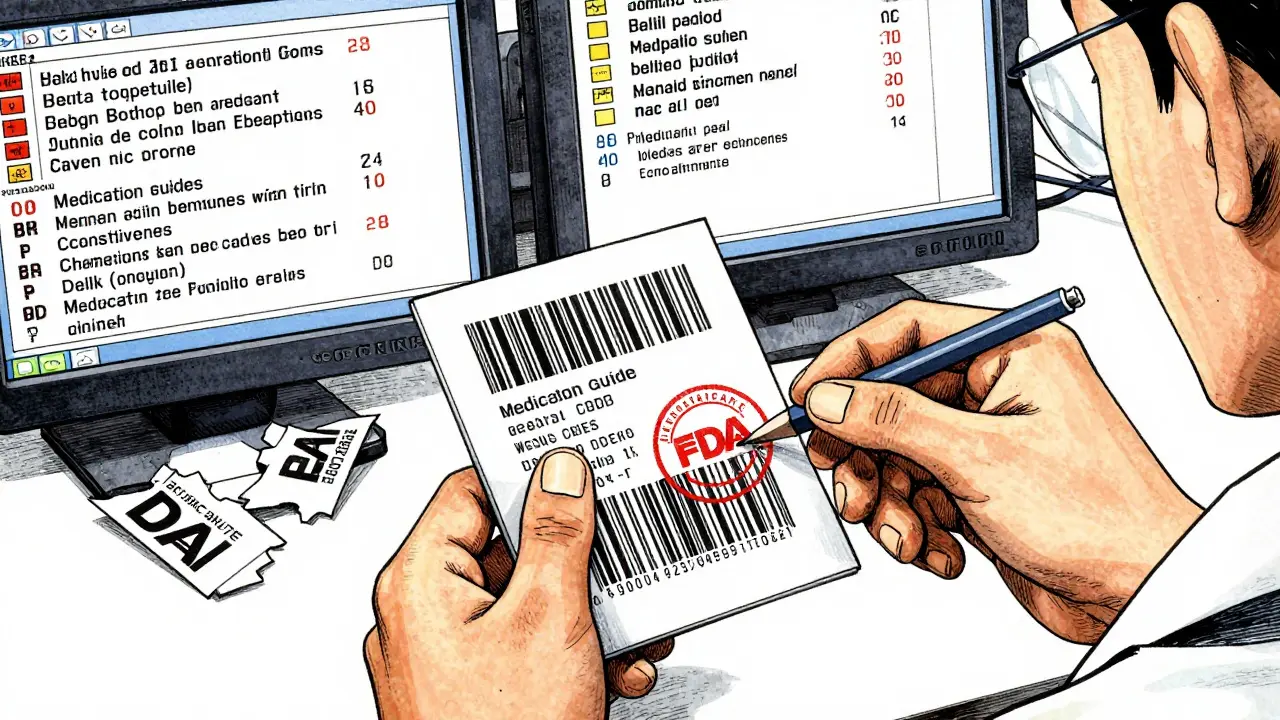
Some institutions have cracked the code. The University of California San Francisco Medical Center cut distribution errors by 73% by integrating Medication Guide alerts into their pharmacy software. When a prescription is filled, the system checks the drug’s status and automatically flags whether a guide is needed-and whether it’s been distributed before.
Other best practices:
- Create a checklist for each practice setting (community pharmacy, infusion clinic, discharge pharmacy)
- Train staff quarterly on updates
- Use barcodes on guide packaging to scan and track distribution
- Post clear rules in the pharmacy area
One community pharmacy in Texas started keeping a logbook: “Patient Name, Drug, Date Guide Given, Version.” Within six months, their compliance rate jumped from 68% to 98%.
The Bigger Picture: Is This Working?
There’s debate. Some experts say Medication Guides are essential. Dr. Janet Woodcock, former head of FDA’s drug center, called them “essential tools that help patients understand serious risks.”
Others aren’t convinced. Dr. Lucinda L. Maine pointed out in a 2021 study that there’s little evidence these guides actually reduce hospitalizations or improve adherence for most drugs. And a 2022 study found only 37% of patients could recall key safety points a week after reading the guide.
That’s why the FDA is reviewing the whole program. A congressionally mandated study is due in late 2024. Early signs suggest the agency may expand requirements to more drugs-especially new specialty medications in oncology and rare diseases.
Meanwhile, the industry spends about $18.7 million a year just to create and update these guides. And the FDA reviews roughly 120 new or revised guides every year.
What’s Next?
Expect more changes. The FDA is pushing for better digital options, clearer language, and easier-to-read formats. A draft guidance released in January 2023 wants guides to follow a uniform structure: “What this medicine is,” “What you need to know,” “Possible side effects,” and “What to do if something bad happens.”
By 2026, more drugs will likely require guides. The number could rise by 22% over the next five years. That means pharmacists need to stay sharp-not just on distribution rules, but on how to make sure patients actually understand what they’re reading.
Bottom line: Medication Guides aren’t just paperwork. They’re safety nets. And for pharmacists and providers, knowing when to hand them out-and when not to-is part of the job.
Do I have to give a Medication Guide every time a patient refills a prescription?
Only if the drug is for self-administration in an outpatient setting, like insulin or warfarin. For those, you must give the guide each time. For drugs given in clinics (like chemotherapy or infusions), you only need to give it the first time-unless the guide was updated.
Can I email the Medication Guide instead of printing it?
Yes, but only if the patient agrees. You must still offer a printed copy if they ask for it. The FDA requires paper to be available as an option-it can’t be replaced entirely by digital.
Are Medication Guides required in hospitals?
No. In inpatient settings like hospitals or nursing homes, Medication Guides are not required because patients are under direct supervision. However, staff must still verbally explain risks. If the patient is being discharged with the medication, then the pharmacy must provide the guide before they leave.
What happens if I don’t distribute a required Medication Guide?
You could face FDA enforcement actions, including warning letters, fines, or being flagged in inspection reports. More importantly, you risk patient harm. If someone has a bad reaction and didn’t receive the guide, your facility could be liable.
How do I know if a Medication Guide has been updated?
The FDA posts updates on its website, and many pharmacy systems now alert you automatically. You can also subscribe to the FDA’s Drug Safety Communications. Never assume the guide you have is current-always check before dispensing.





8 Comments