

What Is Polycystic Ovary Syndrome?
Polycystic Ovary Syndrome, or PCOS, isn’t just about cysts on the ovaries. It’s a hormonal disorder that affects 5 to 10% of women during their reproductive years. The name comes from the appearance of the ovaries on ultrasound - packed with small fluid-filled sacs, or follicles. But the real problem isn’t the cysts. It’s what’s happening inside the body: a mess of hormones that throw off ovulation, metabolism, and even mood.
Doctors diagnose PCOS when a woman has at least two of three things: irregular or missed periods, signs of too many male hormones (like facial hair or acne), and polycystic ovaries on scan. The tricky part? Many women don’t get diagnosed until they’re trying to get pregnant. On average, it takes 2 to 3 years from when symptoms first show up to when someone finally gets a clear answer. That delay costs time, confidence, and sometimes, the chance to conceive naturally.
The Hormonal Chaos Behind PCOS
At the heart of PCOS is a broken feedback loop between the brain, ovaries, and pancreas. It starts with insulin resistance - a condition where the body doesn’t respond well to insulin, the hormone that moves sugar from blood into cells. About 50 to 70% of women with PCOS have this, even if they’re not overweight. When insulin stays high, it tricks the ovaries into making too much testosterone. That’s the main male hormone that causes unwanted hair growth, acne, and hair thinning.
At the same time, the brain’s signals get mixed up. The pituitary gland pumps out too much luteinizing hormone (LH) and not enough follicle-stimulating hormone (FSH). This imbalance stops follicles from maturing properly. Instead of releasing one egg each month, the ovaries hold onto many small ones - the "polycystic" look. Without ovulation, progesterone doesn’t rise. That means periods become unpredictable, sometimes skipping for months. And without progesterone to balance it, estrogen keeps building up in the uterus, raising the risk of thickened lining and, over time, endometrial cancer.
Testosterone levels in women with PCOS often sit 1.5 to 2 times higher than normal - around 20 to 30 ng/dL compared to the usual 15 to 25 ng/dL. That’s why 70% deal with hirsutism, 30 to 40% struggle with severe acne, and 1 in 4 notice hair loss on the scalp. Fasting insulin levels? They’re often above 10 μIU/mL, while normal is under 8.4. These aren’t random numbers. They’re the fingerprints of a system in distress.
Why Fertility Is Affected - And How to Fix It
If you’re trying to get pregnant and have PCOS, the main issue is simple: you’re not ovulating regularly, or sometimes at all. But the good news? Most women with PCOS can still conceive - it just often takes a different path.
First-line treatment isn’t a pill. It’s lifestyle. Losing just 5 to 10% of body weight can restore ovulation in 30 to 50% of overweight women. That doesn’t mean drastic diets. It means moving more - 150 minutes a week of brisk walking or cycling - and eating in a way that keeps blood sugar steady. Studies show low-glycemic diets (think whole grains, beans, vegetables) cut insulin levels by 30% in 12 weeks. The DASH diet, originally for high blood pressure, improves menstrual regularity by 35%.
When lifestyle changes aren’t enough, doctors turn to medication. Clomiphene citrate (Clomid) has been the go-to for decades. It works by tricking the brain into releasing more FSH, which helps follicles grow. About 60 to 85% of women on Clomid ovulate, and 30 to 40% get pregnant within six cycles. But for 1 in 5 women, it doesn’t work.
That’s where letrozole comes in. Originally a breast cancer drug, it’s now the preferred first choice for many fertility specialists. In the landmark PPCOS-II trial, letrozole led to higher ovulation rates (88% vs. 70%) and better live birth rates (27.5% vs. 19.1%) than Clomid. It’s now recommended as first-line for women with PCOS trying to conceive, especially if they’re overweight.

Other Medications and When to Use Them
Metformin, a diabetes drug, is often prescribed for PCOS because it improves insulin sensitivity. But here’s the catch: it’s not great at making you ovulate on its own. Only 15 to 40% of women ovulate with metformin alone. Where it shines is when combined with Clomid or letrozole. In women with high BMI or strong insulin resistance, adding metformin can boost pregnancy rates by 30 to 50% compared to ovulation drugs alone.
But metformin comes with a downside. Over half of users report nausea, and 1 in 3 get diarrhea. Many stop taking it within six months - not because it doesn’t work, but because they weren’t given a slow start. Starting at 500 mg once daily and increasing slowly cuts side effects dramatically.
If pills don’t work, the next step is injectable hormones called gonadotropins. These directly stimulate the ovaries. They work well - about 15 to 20% pregnancy rate per cycle - but they come with big risks. There’s a 20 to 30% chance of twins or triplets, and a 5 to 10% risk of ovarian hyperstimulation syndrome (OHSS), where the ovaries swell and leak fluid. It can be serious.
IVF is usually saved for when other treatments fail, or if there are other infertility factors like blocked tubes. Women with PCOS need lower doses of IVF drugs than others - around 150 to 225 IU per day - because their ovaries are extra sensitive. But their OHSS risk is still higher: 10 to 20% compared to 1 to 5% in women without PCOS. Careful monitoring is non-negotiable.
What No One Tells You About PCOS and Mental Health
PCOS doesn’t just mess with your body - it messes with your mind. Depression and anxiety affect 30 to 50% of women with PCOS. Why? Hormones play a part, but so does stigma. A 2022 survey of 1,200 women found that 78% felt judged about their weight during medical visits. Many say doctors focused on their BMI instead of their symptoms. Only 32% were ever screened for mental health issues.
Chronic stress makes it worse. When cortisol (the stress hormone) stays high, it throws off the entire hormonal system - including the brain’s signals to the ovaries. That’s why mindfulness, therapy, or even just regular sleep can be as important as medication.
And let’s talk about the emotional toll of fertility treatment. One woman on Reddit waited four years and saw five doctors before getting diagnosed. Another shared that after three failed Clomid cycles, letrozole worked on the first try - and she got pregnant with twins. Those stories aren’t rare. But they’re not always heard in the waiting room.
What’s New in PCOS Treatment?
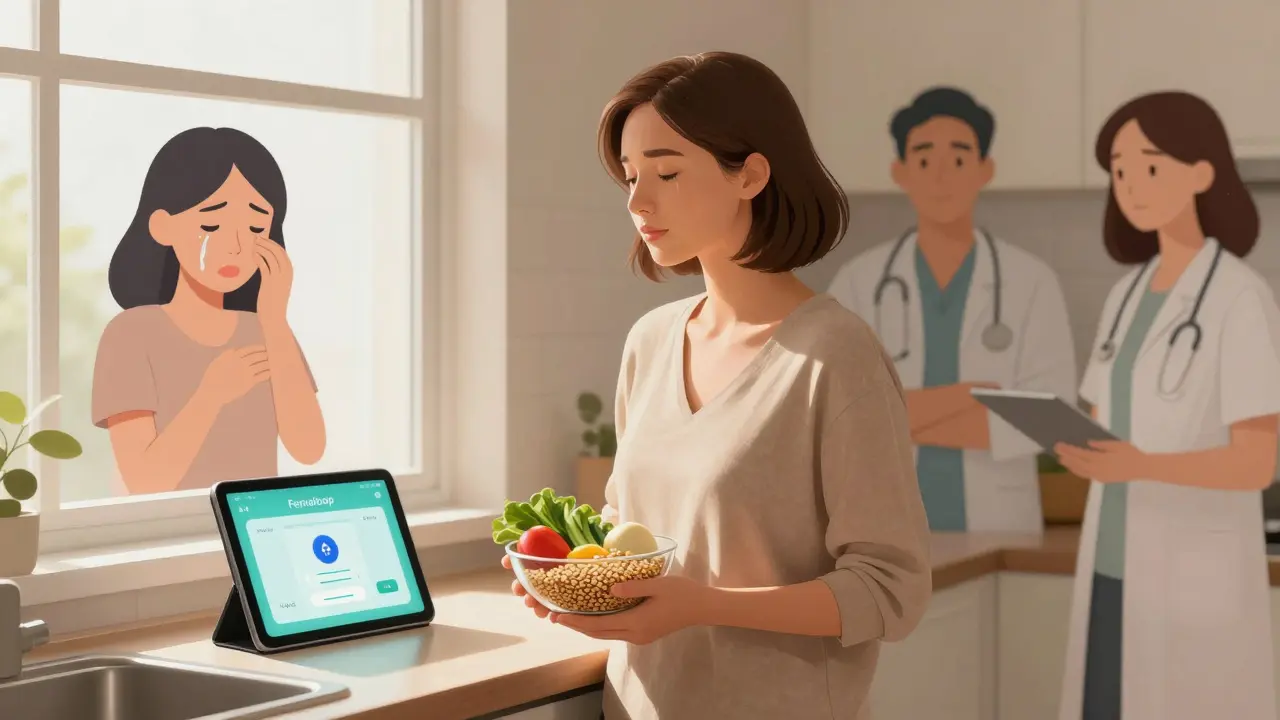
The field is changing fast. In 2022, the FDA approved the first digital therapeutic for PCOS: an app called Femaloop. It uses AI to give personalized diet, exercise, and sleep plans. In trials, it improved menstrual regularity by 28% in six months. That’s not a cure - but it’s a tool that works alongside medicine.
Researchers are also testing new drugs. One combination pill, Myfembree, which includes a hormone blocker and estrogen, showed 89% of women had regular periods versus just 32% on placebo. It’s not yet approved for PCOS, but phase III trials are promising.
AI is also helping with diagnosis. Algorithms that combine blood tests (like AMH levels above 4.7 ng/mL), LH:FSH ratios, and ovarian volume can now predict PCOS with 92% accuracy. That could mean faster diagnosis, especially for teens, where ultrasound alone isn’t reliable.
Long-Term Health Beyond Fertility
PCOS isn’t a problem you outgrow. Even after having children, the risks don’t disappear. By age 40, half of women with PCOS develop type 2 diabetes. Their risk of heart attack is doubled. That’s why annual blood sugar and cholesterol checks are just as important as fertility treatment.
Experts now say PCOS isn’t just a reproductive disorder - it’s a metabolic one. Managing it means thinking long-term: healthy eating, regular movement, monitoring blood pressure and glucose, and not ignoring mood changes. The goal isn’t just to get pregnant. It’s to stay healthy for life.
Final Thoughts: There’s Hope, But It’s Personal
There’s no single fix for PCOS. What works for one woman might not work for another. Some respond to weight loss alone. Others need letrozole. A few need IVF. Some find relief with an app. Others need therapy.
The key is to stop seeing PCOS as a failure of the body. It’s a complex condition shaped by hormones, genetics, and environment. And it’s treatable. With the right team - a gynecologist, an endocrinologist, a dietitian, and maybe a therapist - most women with PCOS can get pregnant and live healthy lives. It takes patience. It takes advocacy. But it’s possible.






14 Comments