

What Is Triple Inhaler Therapy for COPD?
Chronic Obstructive Pulmonary Disease (COPD) isn’t just about feeling winded. For many, it’s a cycle of worsening breathing, hospital visits, and lost days at work or with family. Triple inhaler therapy combines three medications-an inhaled corticosteroid (ICS), a long-acting muscarinic antagonist (LAMA), and a long-acting beta-agonist (LABA)-into one treatment. This isn’t a new idea, but since the 2023 GOLD guidelines, it’s become a targeted tool for specific patients, not everyone with COPD.
Think of it like fixing a leaky pipe with three tools: the LAMA opens the airways, the LABA keeps them open longer, and the ICS dials down the inflammation that causes swelling and mucus. Together, they work better than any two alone-for the right people.
Who Actually Benefits From Triple Therapy?
Not every COPD patient needs this. In fact, most don’t. Triple therapy is meant for those who keep having flare-ups-called exacerbations-despite using dual bronchodilators (LAMA/LABA). The 2024 GOLD guidelines say you’re a candidate if you’ve had two or more moderate exacerbations or one severe one in the past year.
But there’s another key factor: your blood eosinophil count. This is a type of white blood cell linked to airway inflammation. If your count is 300 cells/µL or higher, triple therapy can cut your risk of another flare-up by about 25%. If it’s below 100, the risk of pneumonia from the steroid component outweighs any benefit. That’s why doctors now test this before prescribing.
Real-world data from a UK study of 31,000 patients showed that when you don’t abruptly stop steroids before switching to dual therapy, triple therapy doesn’t offer a clear edge over LAMA/LABA alone. That’s why it’s not a one-size-fits-all-it’s a precision tool.
Single vs. Multiple Inhalers: Adherence Makes the Difference
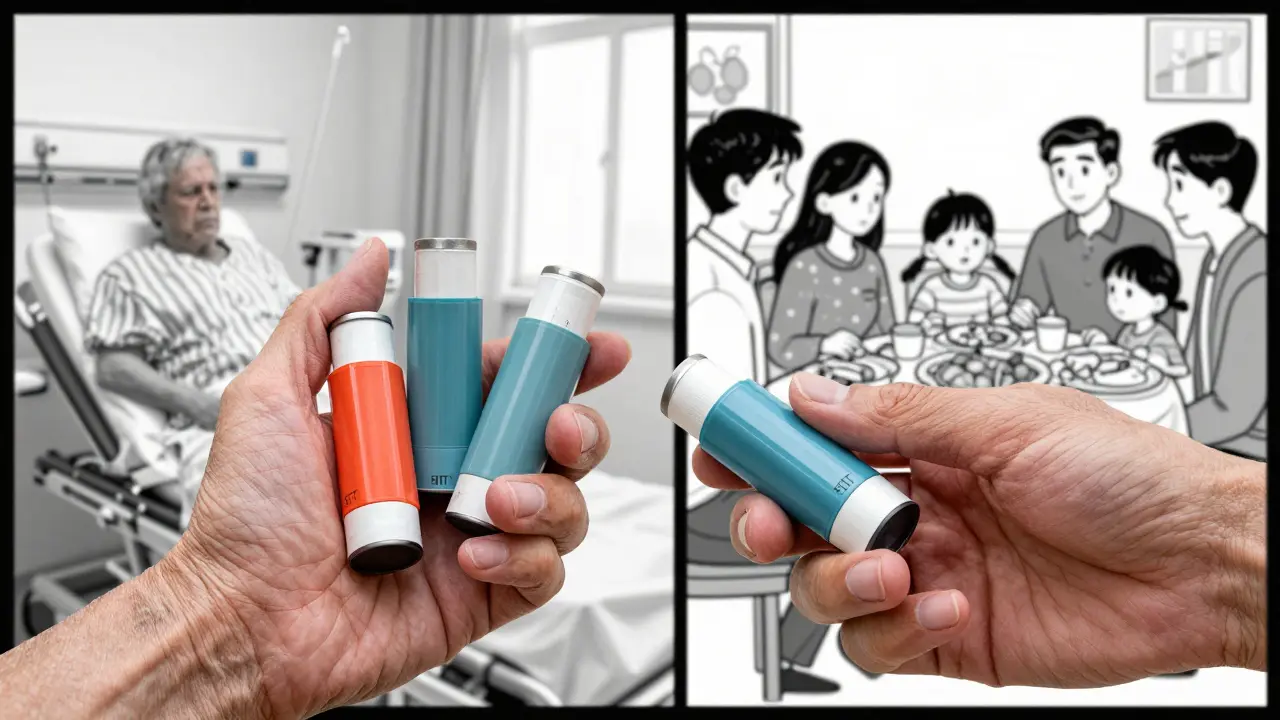
There are two ways to get triple therapy: three separate inhalers (multiple-inhaler triple therapy, or MITT) or one device that holds all three (single-inhaler triple therapy, or SITT).
Here’s the catch: people forget. They mix up which inhaler does what. A study tracking 1,810 patients found that 68% of those using multiple inhalers missed at least one dose. The top reasons? Forgetting and confusion.
Switching to a single device like Trelegy Ellipta (a combination of fluticasone furoate, umeclidinium, and vilanterol) or Trimbow (budesonide, glycopyrronium, and formoterol) changed that. Patients using SITT had 15-20% higher adherence than those juggling three devices. In one study, people who switched from MITT to SITT saw a 37% drop in exacerbations within six months-mostly because they actually took their medicine.
It’s not just about convenience. It’s about survival. Missing doses means more ER trips, more steroids, more time in bed.
The Pneumonia Risk You Can’t Ignore
Every benefit comes with a cost. The steroid in these inhalers-while great for reducing inflammation-also lowers your lungs’ natural defenses against infection.
Studies show people on fluticasone-based triple therapy (like Trelegy) have a 1.83 times higher risk of pneumonia compared to those on budesonide-based versions (like Trimbow). That’s not a small number. It’s why the FDA requires a black box warning on these products.
Signs to watch for: new or worsening cough, fever, chills, or mucus that’s thicker or colored. If you’re on triple therapy and get these symptoms, don’t wait. Call your doctor. Pneumonia in COPD patients can turn deadly fast.
And here’s something many don’t realize: if your eosinophil count is low, the pneumonia risk isn’t balanced by any benefit. That’s why testing isn’t optional-it’s essential.
How It Compares to Other Treatments
Let’s break down what works best for whom:
| Therapy Type | Medications | Best For | Exacerbation Reduction | Key Limitation |
|---|---|---|---|---|
| LAMA/LABA (Dual) | Two bronchodilators | Most COPD patients, low eosinophils | 10-15% | No anti-inflammatory effect |
| Triple Therapy (SITT) | LAMA + LABA + ICS | Frequent exacerbations, eosinophils ≥300 | 20-25% | Pneumonia risk |
| ICS/LABA | Two medications, no LAMA | History of asthma-COPD overlap | 15% | Less bronchodilation than LAMA/LABA |
| Monotherapy | Single bronchodilator | Mild COPD, early stage | 5-10% | Insufficient for moderate-severe disease |
The data is clear: if you’re in the high-risk, high-eosinophil group, triple therapy gives you the best shot at staying out of the hospital. But if you’re not in that group, you’re better off with LAMA/LABA and saving yourself from unnecessary steroid exposure.

Cost, Access, and Real-Life Barriers
Even if you qualify, getting triple therapy isn’t always easy. Brand-name SITT inhalers like Trelegy Ellipta cost $75-$150 a month out-of-pocket in the U.S. That’s a lot for seniors on fixed incomes. One study found that 22% of Medicare beneficiaries skipped doses because of cost.
Some insurers require prior authorization or step therapy-meaning you have to try cheaper options first. That delays treatment and increases risk.
And then there’s the learning curve. Using an Ellipta device correctly takes about 7 minutes of instruction. Mistakes in technique? They account for 50-70% of cases where patients say the inhaler “doesn’t work.” That’s why clinics now use checklists and video demos to ensure patients can actually use their devices.
What’s Next for COPD Treatment?
Triple therapy isn’t the end of the road. Researchers are already looking beyond it. New biologics like dupilumab (a monoclonal antibody targeting IL-4 and IL-13 pathways) are showing promise in patients with eosinophil counts above 300-exactly the same group that benefits from triple therapy.
Future treatment may involve combining these biologics with inhalers, or using biomarkers like fractional exhaled nitric oxide (FeNO) to predict who will respond best. By 2027, experts predict biomarker-guided therapy will be standard.
But right now, triple inhaler therapy is the most effective tool we have for reducing exacerbations in high-risk patients. It’s not perfect. It’s not for everyone. But for those who need it, it can mean fewer hospital stays, more time with loved ones, and better days.
What You Should Do If You Have COPD
- Ask your doctor for a blood eosinophil test if you’ve had frequent flare-ups.
- If you’re on multiple inhalers, ask if switching to a single device could help your adherence.
- Learn how to use your inhaler correctly-watch a video or ask for a technique check.
- Report any new cough, fever, or mucus changes immediately.
- Don’t skip doses because of cost. Ask about patient assistance programs or generic alternatives.
COPD management isn’t about taking more drugs. It’s about taking the right ones, the right way, for the right person. Triple therapy does that-for a specific group. And that’s exactly how medicine should work.





11 Comments