
Pill Splitting Safety Checker
Is This Pill Safe to Split?
Check if your medication can be safely split without causing dangerous side effects or reducing effectiveness.
When you pick up a prescription, you might not think twice about whether it’s a tablet, capsule, or extended-release pill. But the shape and technology behind that little pill can change how your body handles the medicine - and even how often you feel sick. Not all pills are created equal. The difference between a regular tablet and an extended-release version isn’t just about how long it lasts. It’s about how your body absorbs the drug, what side effects you’re likely to get, and whether you’ll stick with the treatment long-term.
How Tablets, Capsules, and Extended-Release Pills Work Differently
Immediate-release tablets dissolve in your stomach within 30 to 60 minutes. Once dissolved, the drug floods into your bloodstream, reaching peak levels in about 1 to 2 hours. That’s why you might feel the effects quickly - but also why side effects like nausea, dizziness, or headaches often show up right after you take the pill. These peaks and valleys in drug levels are normal for immediate-release forms, but they’re also what cause many of the unpleasant reactions.
Capsules, on the other hand, usually dissolve a bit faster than tablets - about 20 to 30% quicker. That’s because the gelatin shell breaks down more easily than the compressed powder in a tablet. This makes capsules a better choice if you need fast relief, like with painkillers or allergy meds. But they don’t last as long. A capsule of ibuprofen might help for 4 hours, while a tablet of the same drug could last a little longer due to slower breakdown.
Extended-release (ER, XR, or XL) pills are designed to do something completely different. Instead of dumping the whole dose at once, they release the drug slowly over 12 to 24 hours. This keeps your blood levels steady, avoiding the spikes that cause side effects. There are four main ways this happens:
- Hydrophilic matrix systems use swelling polymers like HPMC to trap the drug and release it as water slowly seeps in.
- Hydrophobic matrix systems use waxy or insoluble materials to slow down drug diffusion.
- Reservoir systems encase the drug in a membrane that controls how fast it leaks out.
- Osmotic systems use pressure to push the drug out through a tiny laser-drilled hole.
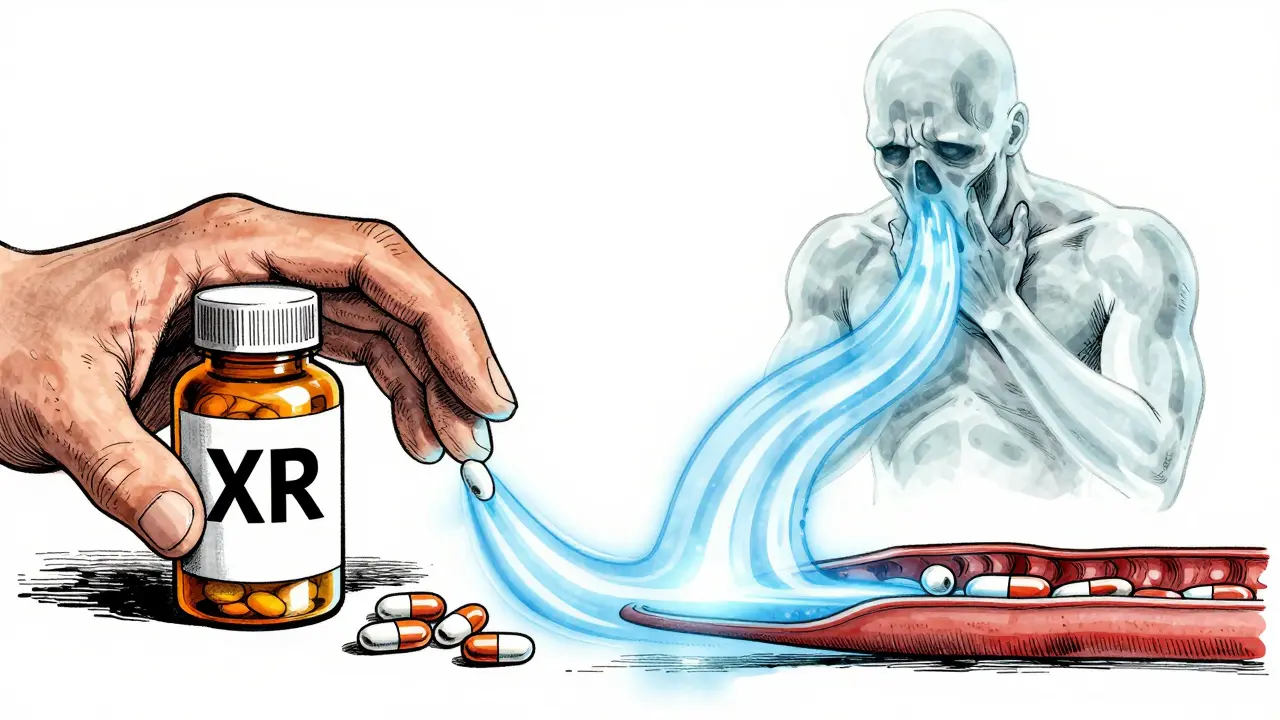
These aren’t just marketing terms. Each method affects how the drug behaves when you eat, when you’re dehydrated, or if you have a slow-moving gut. That’s why some extended-release pills can’t be crushed, chewed, or split - doing so destroys the slow-release mechanism and can cause a dangerous overdose.
Side Effects: Why Extended-Release Often Feels Better
If you’ve ever felt nauseous after taking a regular pill, you’ve felt the effect of a drug peak. High concentrations in your blood right after dosing are the main reason for side effects like dizziness, upset stomach, or jitteriness. Studies comparing immediate-release and extended-release versions of the same drug show a clear pattern: ER forms reduce these reactions.
For example, extended-release bupropion (Wellbutrin XL) cuts nausea by 30% compared to the immediate-release version. In clinical trials, 13.3% of people on the ER version had nausea, versus 19.1% on the regular one. Venlafaxine XR (Effexor XR) shows similar results - 22% fewer cases of dizziness and 18% less nausea than the immediate-release form. These aren’t small differences. They’re the kind that make people stick with their meds.
A 2017 review of 15 studies on antiepileptic drugs found that immediate-release versions caused 25 to 40% more concentration-dependent side effects than their extended-release counterparts. That’s because the body isn’t meant to handle big bursts of drugs. It’s designed for steady levels. Think of it like turning a faucet on full blast versus letting it drip slowly. One floods the system. The other keeps it balanced.
Patients notice this too. On Drugs.com, extended-release medications average 4.2 out of 5 stars, while immediate-release versions sit at 3.8. The top reason? Fewer side effects. The second? Fewer pills to take. One user wrote: “I used to take three pills a day for my depression. Now I take one. I don’t feel sick anymore.”
The Hidden Downsides of Extended-Release Pills
Extended-release isn’t perfect. It’s more complex, and that complexity comes with risks.
First, you can’t adjust the dose easily. If you need to lower your dose by 25%, you’re stuck. Most ER pills come in fixed strengths - no half-pills allowed. That’s a problem for older adults, people with kidney or liver issues, or those who need fine-tuned dosing. About 38% of doctors say they struggle with titrating ER medications for sensitive patients.
Second, food can mess with absorption. High-fat meals can increase drug release by 20 to 35% in some extended-release products. That’s why some labels say “take on an empty stomach.” If you take your ER medication with a greasy breakfast, you might get too much drug too fast - and end up with side effects you thought you’d avoided.
Third, if your digestion is slow - like in gastroparesis or after surgery - the pill might not move through your gut properly. In 5 to 10% of these patients, the drug doesn’t release at all, or it releases too late. That’s called “dose dumping,” and it can lead to either no effect or sudden overdose. The FDA has had to update labels for 12% of ER products approved between 2010 and 2020 because of these unpredictable effects.
And then there’s the size. Extended-release pills are often bigger. Elderly patients and those with swallowing problems report trouble with them. A 2022 Mayo Clinic survey found that 27% of negative reviews for ER meds mentioned difficulty swallowing. Some patients end up crushing them anyway - which can be dangerous.
Cost, Convenience, and Compliance
Extended-release versions cost more. On average, they’re 2.3 times pricier than immediate-release equivalents. A month’s supply of generic immediate-release bupropion might cost $15. The extended-release version? $185. That’s a huge barrier for people without good insurance.
But here’s the catch: even though ER pills cost more upfront, they often save money in the long run. Why? Because people take them more consistently. A case study from UPM Pharmaceuticals showed a patient with bipolar disorder went from 65% adherence on three daily doses to 92% on one daily ER dose. Over 12 months, that meant 47% fewer mood episodes - and fewer hospital visits.
Compliance isn’t just about feeling better. It’s about staying alive. In conditions like epilepsy, hypertension, or depression, missing a dose can trigger seizures, spikes in blood pressure, or suicidal thoughts. Extended-release formulations reduce that risk simply by making it easier to remember one pill instead of three.
What the Labels Don’t Tell You
The naming system for these pills is a mess. You’ll see SR (sustained-release), ER (extended-release), XR (extended-release), XL (extended-release), DR (delayed-release), and CR (controlled-release). They’re not always the same. A “SR” tablet might release over 8 hours. An “XR” might last 24. A “DR” (like enteric-coated valproate) doesn’t release until it hits the intestine - which is different from extended release entirely.
Doctors and pharmacists need to know the difference. A 2021 analysis by the Institute for Safe Medication Practices found that 12% of medication errors involving these drugs happened because someone confused an ER version with an immediate-release one. That’s not just a mistake - it’s a safety risk.
What’s Next for Medication Formulations
Technology is getting smarter. The FDA approved Rytary in 2023 - a multi-pulse extended-release carbidopa-levodopa pill that delivers three separate doses over the day. It cuts “off” time in Parkinson’s patients by over two hours. That’s huge.
Researchers are now testing pills that stay in the stomach for 24 hours, or that release drugs only in specific parts of the intestine. These could help with HIV meds, diabetes drugs, or even antibiotics that need to target the gut.
But there’s a dark side. The polymers used in these pills don’t break down easily. A 2022 study from the University of Toronto found these materials in 78% of wastewater samples. We’re literally flushing plastic into our water supply.
By 2030, nearly half of all oral pills will be extended-release. Aging populations, chronic disease trends, and the push for better compliance will drive that growth. But we’ll need better labeling, clearer patient education, and smarter dosing options to make sure these advances don’t create new problems.
What Should You Do?
If you’re on a medication and keep having side effects, ask your doctor: “Is there an extended-release version?” It might not be cheaper, but it could be gentler on your body.
If you’re switching from immediate-release to extended-release, don’t assume it’s the same dose. The amounts aren’t always equal. Always check with your pharmacist.
Never crush, split, or chew an extended-release pill unless your doctor says it’s safe. Some newer formulations are designed to be split - but most aren’t.
If you have trouble swallowing pills, ask about liquid versions, patches, or other delivery methods. Don’t force yourself to take something that feels unsafe.
And if cost is an issue, ask about generic alternatives. Sometimes, the immediate-release version is still the better choice - especially if you can take it at consistent times and tolerate the side effects.
Can I split an extended-release tablet?
Only if the label or your doctor specifically says it’s safe. Most extended-release tablets are designed to release medication slowly over time, and splitting them can cause the entire dose to release at once. This can lead to overdose or dangerous side effects. Some newer formulations are scored and approved for splitting, but never assume - always check the prescribing information or ask your pharmacist.
Why do some extended-release pills look the same after I take them?
That’s normal. Many extended-release pills use a non-digestible shell or matrix that doesn’t break down in your body. What you see in the stool is just the empty carrier - like a capsule that never dissolved. The drug was released inside your gut. It’s not a sign the pill didn’t work. In fact, seeing the shell intact means the delivery system did its job.
Are extended-release medications better for everyone?
No. They’re best for people who need steady drug levels and struggle with side effects from immediate-release versions. But they’re not ideal for those with slow digestion, swallowing problems, or who need quick dose adjustments. People with gastroparesis, recent bowel surgery, or severe constipation may absorb these pills unpredictably. Always discuss your medical history with your doctor before switching.
Do extended-release pills cause fewer side effects overall?
Yes, for concentration-dependent side effects like nausea, dizziness, headaches, and jitteriness. Because these formulations avoid high peaks in blood drug levels, they reduce the intensity of these reactions. Studies show up to 40% fewer side effects for drugs like bupropion, venlafaxine, and carbamazepine when switched to extended-release. But they don’t eliminate all side effects - some are caused by the drug itself, not the release speed.
Can I switch from a capsule to a tablet without changing the dose?
Not always. Even if the active ingredient is the same, the formulation affects how quickly the drug enters your bloodstream. A capsule might absorb faster than a tablet, so switching could change your blood levels. Always consult your pharmacist or doctor before switching between different dosage forms, even if the name and strength look identical.



16 Comments
So basically, if my antidepressant makes me feel like a shaken soda can, switching to the XR version might just save my sanity? 🤔
Always check with your pharmacist. Simple advice. Lifesaving.
My uncle took ER metformin after stomach issues with regular. No more bloating. One pill a day. Life changed.
I used to crush my dad’s ER pills because he said they were too big. Turned out he was getting dizzy from the sudden spike. We switched to liquid. He’s been stable for 2 years now. Don’t assume anything.
Extended-release? More like extended-profit. Big Pharma’s latest scam to charge $200 for what should cost $15. They don’t care if you swallow a plastic shell - they just want your cash. This isn’t medicine, it’s corporate extortion.
And don’t even get me started on the ‘dose dumping’ nonsense. You think they tested that on real people? Nah. They tested it on lab rats and then slapped a ‘FDA-approved’ sticker on it. We’re guinea pigs.
They don’t want you to know you can take two regular pills instead of one fancy one. They want you hooked on the expensive version. The fact that you’re swallowing plastic and calling it ‘science’? That’s the real tragedy.
And now they’re flushing this crap into our water supply? Great. So now we’re drinking microplastics AND taking drugs that leak into the ecosystem. Welcome to the future, folks.
Don’t be fooled. This isn’t innovation. It’s greed dressed up in white coats.
Oh wow, so you mean the pills that cost 12x more are somehow magically better? That’s not science - that’s a marketing gimmick wrapped in a polymer shell. I’ve been on XR bupropion for 3 years and still get headaches. So much for ‘steady levels.’
And let’s be real - if you’re swallowing a whole damn capsule that looks like it came from a sci-fi movie, you’re not healing, you’re just swallowing a plastic robot. I’d rather take three little pills and know exactly what’s happening.
Also, ‘dose dumping’? That’s just corporate speak for ‘we didn’t test this on real people with real guts.’ You think they ran trials on someone with gastroparesis? Please. The FDA approves these things based on 3-month studies with healthy college kids.
And don’t even get me started on the ‘non-digestible shell’ thing. You’re literally shitting out plastic. That’s not medicine - that’s a landfill with a prescription label.
Okay but have y’all noticed how the ER versions always come in these giant, weirdly shaped pills that look like they were designed by someone who hates humans? I swear, the first time I tried to swallow one, I felt like I was choking on a golf ball. My throat just said NOPE.
And then you get the label saying ‘take on empty stomach’ - but what if you’re a working mom who eats breakfast while juggling three kids and a coffee spill? Like, I can’t just pause life for a pill. And now I’m supposed to worry about whether my avocado toast is ‘too fatty’ and will turn my medicine into a time bomb? No thanks.
I switched from the immediate-release version of my anxiety med to the XR because everyone said it’d be gentler… and honestly? It was. Less nausea, less jittery mornings. But now I’m stuck with this monolith pill that costs $185 a month and I have to take it at 7am sharp or it’s basically useless. So yeah, it’s better… but also a whole new kind of stress.
And the fact that some of them look the same after you take them? I thought I was hallucinating. Like, I literally Googled ‘is this my pill still in my poop?’ I was so confused. Turns out it’s just the shell. Cool. So now I’m just a human who poops out plastic capsules? That’s… oddly poetic, I guess?
Also, the naming system? SR, ER, XR, XL, DR, CR - it’s like they’re trying to confuse us on purpose. I once asked my pharmacist if my ‘SR’ was the same as my friend’s ‘XR’ and she just sighed and said, ‘It’s complicated.’ Thanks, I hate it.
And now we’re polluting the water supply with the polymers? I didn’t sign up for this. I just wanted to feel better, not become part of a bio-plastic experiment.
Just wanted to say thank you for this post 🙏 - I’ve been on XR venlafaxine for a year and I didn’t realize how much better I felt until I read this. The dizziness? Gone. The nausea? Almost nothing. I used to take 3 pills a day and felt like I was on a rollercoaster. Now it’s one. I sleep better. I cry less. I actually show up for my life.
And the fact that you mentioned the cost? Yes, it’s expensive. But I applied for patient assistance and got it for $10/month. If you’re struggling, ask your pharmacist - they know all the programs. Don’t give up because of the price tag.
Also, seeing the shell in your poop? Totally normal. I used to freak out until my pharmacist showed me a diagram. Now I just say, ‘Hey, good job, little pill.’ 🤗
If you’re on meds and feeling off - ask about XR. It might not be perfect, but it might be the thing that finally lets you breathe again.
Wait, so you’re telling me I’m supposed to trust a pill that doesn’t even dissolve? That’s not medicine, that’s a magic trick. Who designed this? A magician? A prison guard? Someone who hates people?
I’ve been swallowing these things for years and I still don’t know if they’re working. I just stare at the toilet and hope the shell doesn’t come out whole. What if it’s just sitting in my gut like a tiny alien? What if it’s leaking into my brain right now? What if I’m hallucinating because of the plastic?
You think I’m paranoid? Look at the wastewater study. We’re literally poisoning ourselves with pills. This isn’t healthcare. It’s a slow-motion suicide pact with Big Pharma.
Let me just say, as someone who has personally ingested more pharmaceutical-grade polymers than the average human has had hot dinners - this is not science, it’s sorcery. The fact that you’re swallowing a tiny, engineered prison for your medication and then expecting it to behave like a well-mannered guest in your GI tract? That’s not pharmacology - that’s a goddamn Rube Goldberg machine built by chemists who skipped breakfast and took a nap in a lab coat.
And don’t get me started on the naming conventions. SR? ER? XR? XL? DR? CR? It’s like they’re trying to confuse you into submission. Is this a pill or a password for a secret society? ‘The Order of the Slow Release’? You need a PhD just to know if you’re supposed to take this with or without a side of scrambled eggs.
And the fact that some of these things are scored? Oh, you mean I can split this $185 plastic bullet? Only if the label says so? Only if the pharmacist doesn’t look at me like I’m a toddler holding a grenade? Oh, okay. So I’m not allowed to be a responsible adult unless I’ve got a 17-page consent form signed by my great-grandmother’s ghost.
And let’s talk about the ‘dose dumping’ phenomenon. That’s not a side effect - that’s a plot twist in a horror movie. You take your pill, you eat your burrito, and suddenly your body turns into a drug grenade. ‘Oops, sorry, the membrane failed. You’re now at 3x your intended dose. Have a nice day!’
And now we’re flushing this plastic into the water supply? I’m not mad, I’m just disappointed. We’ve created a world where the solution to our health problems is to turn our bodies into recycling plants for synthetic polymers. Bravo, humanity. You did it.
Next up: pills that release medication only when you’re emotionally vulnerable. I’m calling it ‘Empathy-Triggered Delivery.’ I’ll patent it. And charge $250.
Hey, I just wanted to say - if you're struggling with side effects, don't give up. I was on immediate-release sertraline for months and felt like I was drowning. Switched to XR. Took a week. Now I wake up and actually feel like me again. It's not perfect, but it's worth it. Talk to your doc. Ask about generics. You're not alone.
How quaint. You think extended-release is a breakthrough? In the West, perhaps. In countries with real medicine - like India - we use traditional formulations with precise dosing, no plastic shells, and no corporate profit motive. This is pharmaceutical theater. You’re paying for packaging, not pharmacology.
And you call it ‘compliance’? That’s just a fancy word for ‘forced dependency.’ Why not fix the healthcare system instead of designing pills that look like space tech? The real problem isn’t the pill - it’s the system that makes you need it in the first place.
Also, 78% of wastewater samples contain these polymers? Of course they do. You’re treating your body like a disposable container. That’s not progress. That’s collapse dressed in a white coat.
They’re watching you through the pills. The shell? It’s a tracker. The polymer? It’s a signal transmitter. You think they care about your nausea? No. They care about your data. Every time you swallow one, they know you took it. When. Where. How you reacted. This isn’t medicine - it’s surveillance with a prescription.
I had a friend who couldn’t swallow pills at all. We found a liquid version of his med. He’s been stable for 3 years now. Sometimes the answer isn’t a fancy pill - it’s just a different way to get the same help.
Wait - you said the ER version cuts nausea by 30%? That’s not a win - that’s a consolation prize. The real win would be a drug that doesn’t cause nausea in the first place. But hey, let’s just make the side effects less obvious and call it ‘innovation.’
Also, you mentioned the cost difference. $15 vs $185? That’s not a pricing gap - that’s a robbery with a pharmacy receipt. You think they’re spending $170 on better polymers? Nah. They’re spending it on lawyers, lobbyists, and a new yacht for the CEO.
And don’t get me started on the ‘patient assistance’ programs. That’s not charity - that’s a trap. You have to fill out 17 forms, prove you’re poor enough, and wait 6 weeks. By then, you’ve already stopped taking it because you couldn’t afford the first month.
They’re not trying to help you. They’re trying to make you dependent on their overpriced plastic.
Thank you for saying this - I’ve been waiting for someone to call out the cost scam. I got my XR med through a nonprofit program, but I know so many people who just quit because they couldn’t afford it. We need real reform, not just ‘patient assistance’ that feels like a handout with fine print.
And you’re right - the real win would be better drugs, not better packaging. But until then, I’ll take the less nausea, even if it costs a fortune. At least I’m alive to complain about it. 💙